Paula Rosa Kitchens
Scoping a D2C MVP for a B2B Kitchen Retailer
A 6-month project to define what Paula Rosa Kitchens needed to build, and what the business needed to fix, before a single screen went live.
TIMELINE
May - Oct 2025
TYPE
Client Project
PLATFORM
E-Commerce (Web)
MY ROLE
Research, service design, product strategy, MVP Scoping
THE PROBLEM
Paula Rosa Kitchens had the manufacturing capability and the product range to compete in the D2C kitchen market however what they didn't have was a website, a consumer-facing catalogue, or any operational infrastructure built for individual orders. Their entire business was structured around volume B2B, 50 identical units to a single contractor on a building site, not the one bespoke kitchen to a homeowner on a cul-de-sac in Bristol.
THE BRIEF
The brief was to scope an MVP matching their target competitor, DIY Kitchens' core e-commerce experience. Alongside a senior strategist, we had to work out whether that was achievable given where Paula Rosa's operations were starting from, and what it would take to get there.
DISCOVERY: UNDERSTANDING THE BUSINESS FIRST
My first decision was to sequence discovery deliberately; map Paula Rosa's existing operations before speaking to customers. If we understood what the business could actually support, we could design a D2C service that worked with the existing model rather than assuming capabilities that weren't there. Going to customers first would have generated an idealised experience brief Paula Rosa's operations couldn't fulfil.
We expected reasonably mature internal systems. What we found was almost entirely manual. Four operational gaps, each with a direct implication for what could realistically launch:
Manual order processing
Fulfilment ran on legacy tools requiring individual data entry. Error rates were already a problem at B2B volumes, D2C would compound them.
Product data built for internal use
The catalogue used internal codes with no consumer-facing naming. Full restructuring was required before any product page could go live.
No digital support layer
Customer service ran entirely through phone agents. No self-service, no CRM, no automated handling, not viable at consumer volumes.
Last-mile delivery
Vehicles were sized for building sites as opposed to residential streets. A third-party last-mile partner therefore became a launch dependency.
DISCOVERY: UNDERSTANDING THE KITCHEN BUYING JOURNEY
We ran 12 in-depth interviews with recent kitchen buyers across DIY Kitchens, Howdens, Magnet, IKEA, B&Q and Wren - covering the full journey from deciding to renovate through to in-life ownership. Three findings directly shaped the MVP.
Choice paralysis was a big barrier to purchase
The early stages of the kitchen journey were described as simultaneously exciting and overwhelming. Customers had plenty of inspiration but no easy way to convert it into confidence. Several delayed starting entirely because the jump from "browsing" to "planning" felt too large.
Trust is often won before anyone visits the website
Customers validated every company through reviews, real photos, and word of mouth before engaging seriously. They were sceptical of polished marketing and sought out unfiltered evidence, TrustPilot 3–4 star reviews specifically, because they felt more credible than five-star ratings. For a brand with no consumer track record, this was a real barrier to entry that couldn't be designed around.
The planning tool was a source of real anxiety
Even customers who successfully used online planning tools described them as daunting. Most leaned on builders or family members to get through it. Dropping someone into a complex planner without preparation would increase abandonment, not reduce it. This reinforced the case for something lighter upstream.
THE SERVICE BLUEPRINT
Discovery gave us a detailed picture of where Paula Rosa's operations would struggle under D2C demand. The service blueprint was how we turned that into something the business could actually act on.
It mapped the full end-to-end D2C service; the customer journey with various touchpoints on one axis and the internal processes, roles, and systems required to support them on the other. The goal was to give operations and the IT team a shared, concrete picture of what needed to change and in what order, before any technical scoping began.
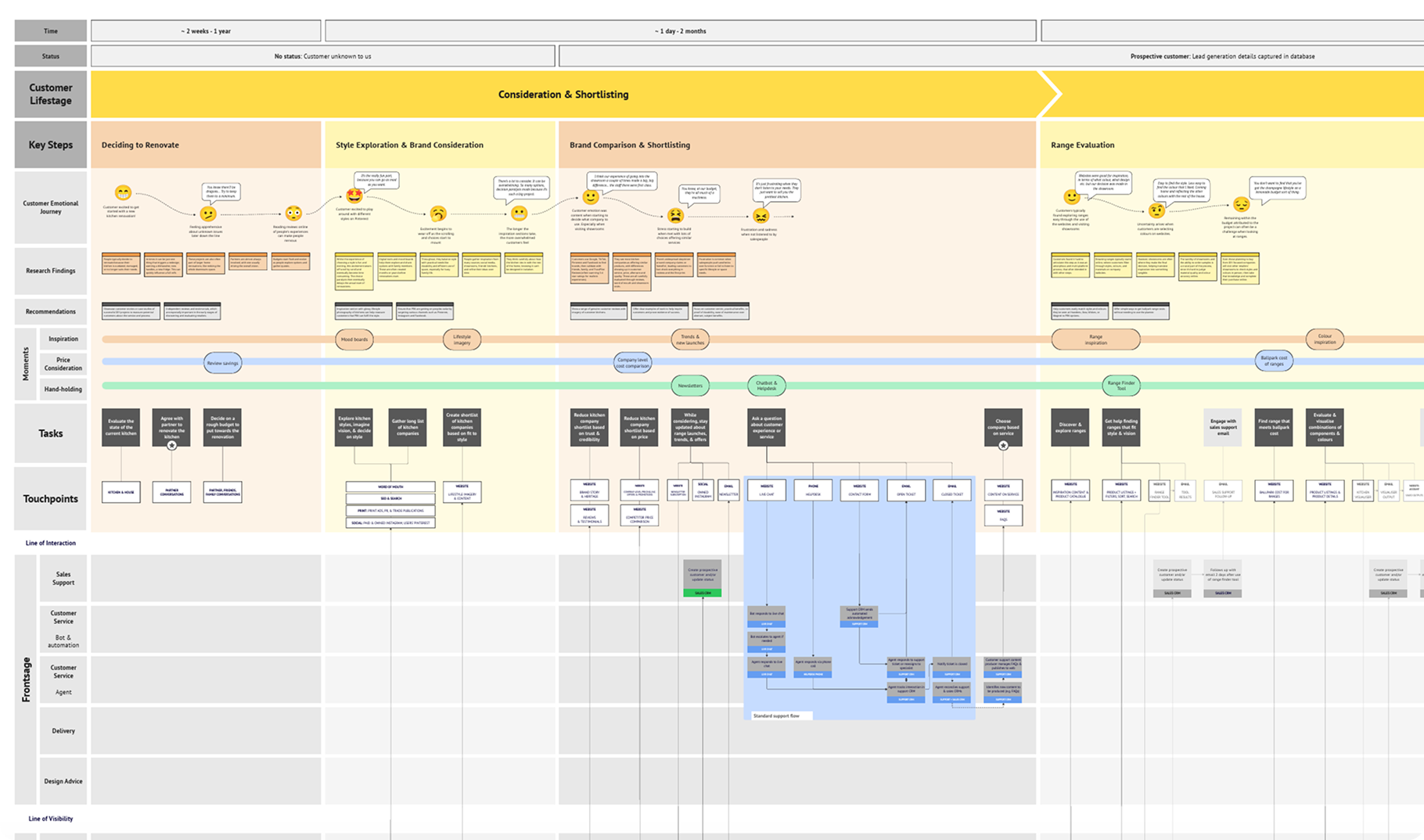
The Final Service Blueprint as presented back to Paula Rosa Clients (IT Lead & Head of Operations)
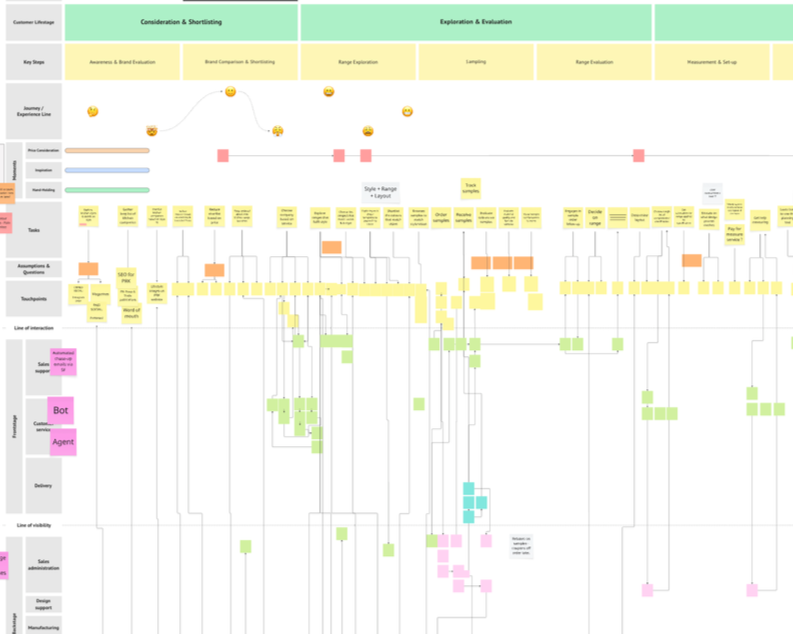
An early first draft of the service blueprint used for internal alignment
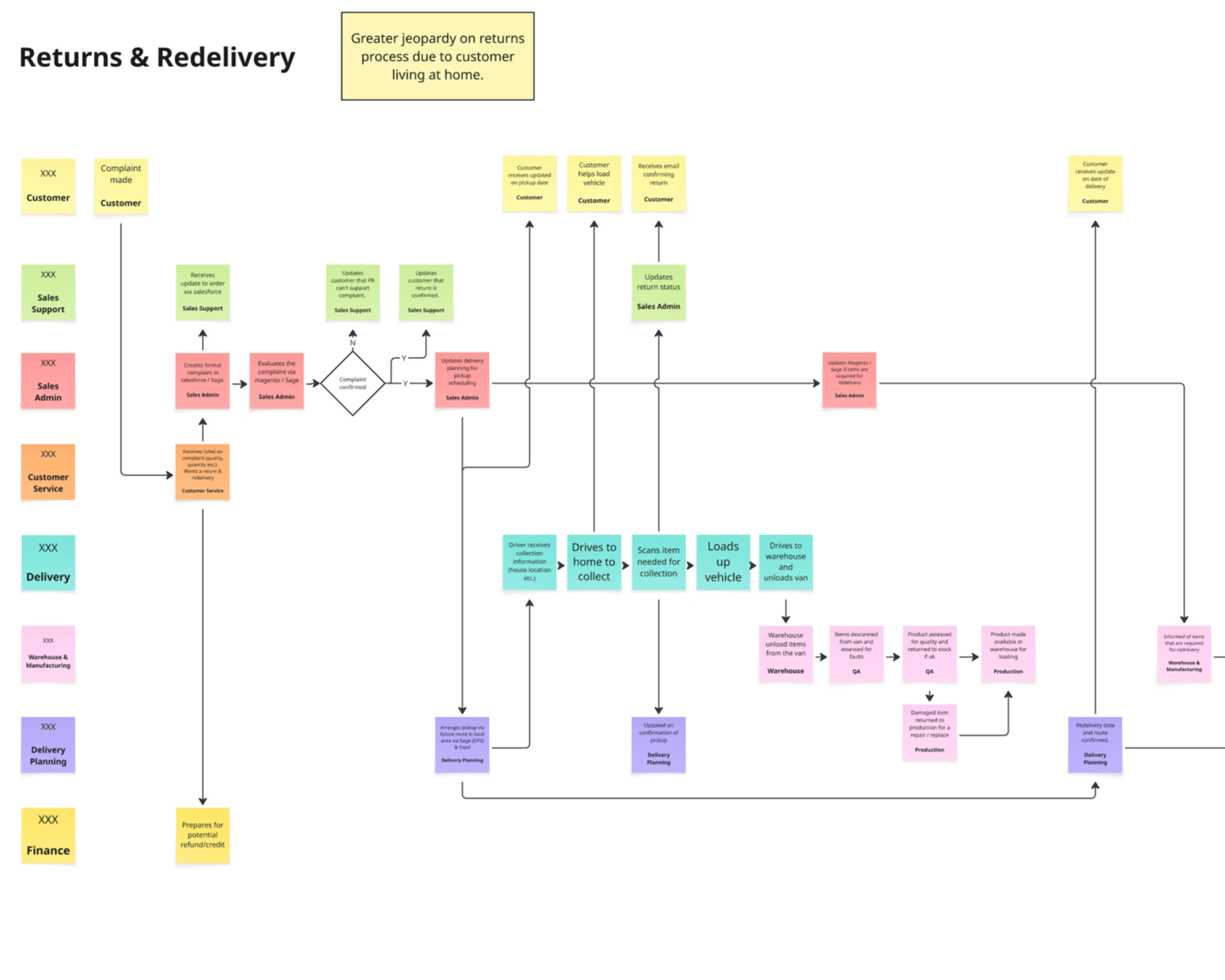
A deep dive into the complexities around returns and redelivery
SERVICE BLUEPRINT: KEY AREAS
Four areas that shaped the service design
-
The existing delivery model wasn't designed for residential addresses or small parcel returns. We recommended a third-party last-mile partner to handle flexible deliveries and returns, a dependency that had to be resolved before launch.
-
B2B returns could take 1–2 weeks without issue. A consumer waiting with two loose cabinet doors in a half-finished kitchen is a different problem. We designed a returns flow that triggered a replacement order simultaneously in the e-commerce platform and ERP, automatically generating a redelivery and collection request. One customer action, one automated chain.
-
Internal roles were built around B2B account management, deep product specialists helping developers configure large orders. D2C required generalist customer agents able to handle quick consumer queries over chat or phone. Several roles therefore needed redefining.
-
Mapping the full communication timeline revealed Paula Rosa had no email notification or CRM strategy for consumer lifecycle marketing. The blueprint became the foundation for the marketing team's communication plan, a deliverable that hadn't initially been scoped at the start of the project.
PRODUCT DATA ARCHITECTURE
The competitor audit confirmed that credible kitchen e-commerce runs on precise, well-structured product data, DIY Kitchens and Howdens had the most granular filtering and specifications of any competitor. A key audience and use case are kitchen fitters who need to locate an exact item quickly. Paula Rosa's catalogue wasn't currently built to support that.
To understand the full scope of what needed to change, I used OOUX (object-oriented UX) to map not just what products existed, but how they related to each other. Cabinets have doors; doors have compatible handles; handles have finishes. That relationship mapping directly informed the cross-sell logic and product detail page architecture and flagged that just a standard feature audit would have missed the dependency chain entirely.
From OOUX to entity relationship mapping. Once the object relationships were mapped, I translated them into an entity relationship diagram for the tech team, showing how product components connected at a data level across product pages, the planning tool, and the catalogue. This fed directly into technical sizing and shaped what was feasible to include in MVP scope versus what would need to come later.
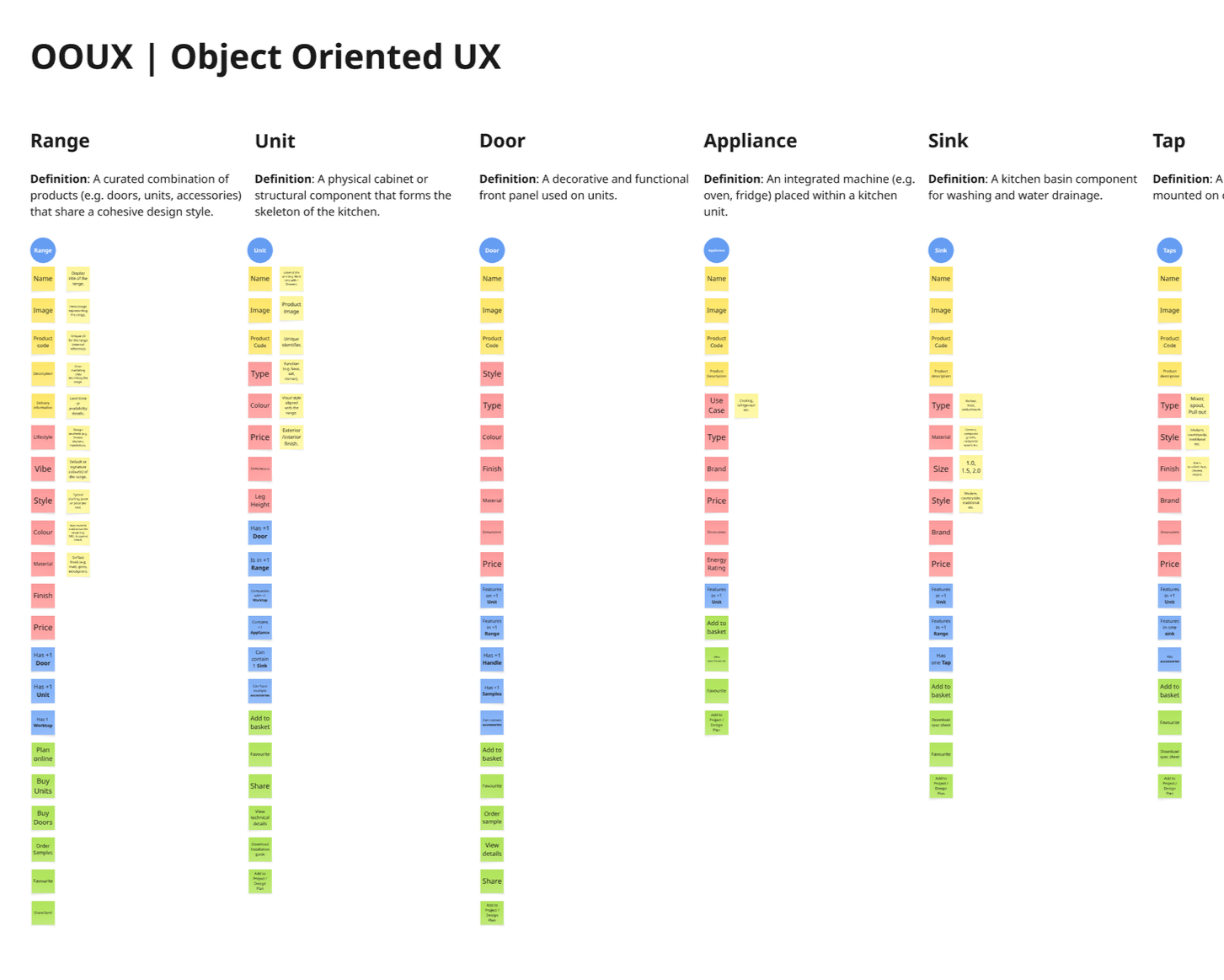
Mapping the various attributes of the components that made up the product catalogue
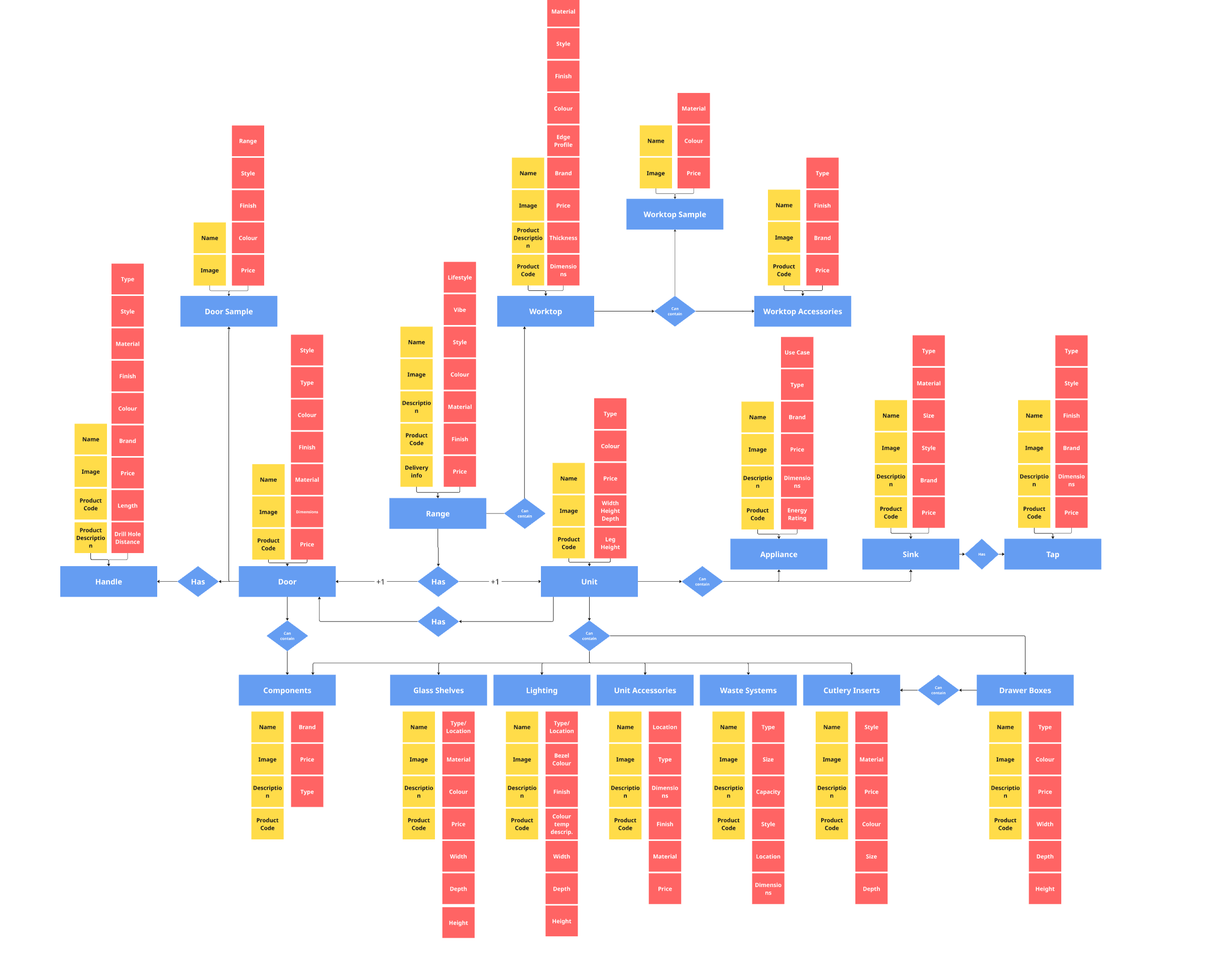
Showing the relationships between different components to inform the tech team.
SCOPING THE MVP
Working with the strategist, we moved from a long feature list to a sized, prioritised MVP using three principles. I defined the early lifecycle tool options, wrote user stories in Jira, sized design effort per feature, and led the deprioritisation rationale on specific calls.
PRINCIPLE 01
Parity first
Match DIY Kitchens on the fundamentals. Their experience was tried and tested and meant Paula Rosa could get to market quickly.
PRINCIPLE 02
Then differentiate
Target the early lifecycle experience, our research had confirmed that it was a clear gap and that competitors were ignoring it.
PRINCIPLE 03
Stay lean
Buy as opposed to build. Lean on third-party tools that could handle complexity, planning, logistics and hand off.
The differentiator that wasn't in the brief: The early lifecycle tool, a lightweight range finder and cost estimator, came directly from research. Customers were abandoning before they reached the planner because the jump from browsing to planning felt too large. The tool would give customers a starting point before entering the third-party planner: pre-saved selections, no blank slate and warmer leads for marketing. We scoped four fidelity options for the client so they could make a cost-informed decision on how far to take it.
THE CALL I PUSHED BACK ON
Wishlisting was cut on cost grounds. I disagreed. Saving items from the catalogue directly into the planner would have reduced the blank-slate anxiety our research flagged, and made the handoff between Paula Rosa's site and the third-party tool feel connected rather than disjointed. It was deprioritised, but I'd call it the highest-value quick win post-launch, the kind of feature that sits at the intersection of user anxiety and conversion, which is where the commercial case is easiest to make.
WHAT HAPPENED?
The project stalled after handover. Paula Rosa aligned with the strategic vision but the gap between pre and post-MVP operational investment created a budget constraint that paused progress. They opted to launch the parity build first and introduce the early lifecycle tool in a later phase, a reasonable sequencing call given where they were starting from.
One signal that the work held up: across a personnel change and a period of budget pause, an incoming designer was able to deliver directly from the original outputs without needing to rebuild the rationale. Proving that my documentation was consice and easy to pick up from.
WHAT I’D TRACK IN THE FIRST 90 DAYS
Planner entry conversion
Are there enough entry points into the tool? This was the biggest distinction in raising AOV. Poor planner conversion would be detrimental to the experience.
Planner abandon rate
The primary signal of friction. A high rate validates the lifecycle tool argument retrospectively.
Average order value
Whether customers are building full kitchens or browsing single items. The lifecycle tool hypothesis lives or dies here.