Stagecoach
Redesigning first impressions for 2.5 million daily bus passengers
A 1-month product design project untangling retention, onboarding, and account creation for Stagecoach.
TIMELINE
Feb - Mar 2025
TYPE
Client Project
PLATFORM
iOS & Android
MY ROLE
Research, strategy, design and testing
THE REAL PROBLEM
Stagecoach came to us with a retention problem and a hypothesis: a slow, confusing first experience was driving users away. The client hypothesis was that if we guide users on how to use the app it would help retain customers. The brief was therefore to redesign the onboarding and increase sign-up rates.
Before designing anything, I pushed to interrogate that hypothesis. If onboarding wasn't the root cause, we'd be solving the wrong problem.
~ 160k
Montly Downloads
10%
Opt-out for permissions
-15 NPS
Driven by ops, not UX
Critical early decision: The data told us that there was an activation problem and that a meaningful share of churn was driven by the core product experience as opposed to the entry point. We defined the boundary of what onboarding could and couldn't fix before designing anything, and held that line with the client.
WHAT SHAPED OUR DIRECTION
Rather than starting from scratch, I drew on discovery research conducted six months earlier. One insight reframed our entire approach: Stagecoach users typically open the app when something needs to happen right now; checking a time, buying a ticket, seeing where the bus is. Often at the bus stop, or walking out the door.
This meant any friction in onboarding was annoying and actively competing with the reason they'd downloaded the app. Speed to value therefore became a critical cornerstone of our solution.
Competitor analysis confirmed that the best-performing travel apps move account creation to post-checkout, not upfront. We adopted this as a design principle early.
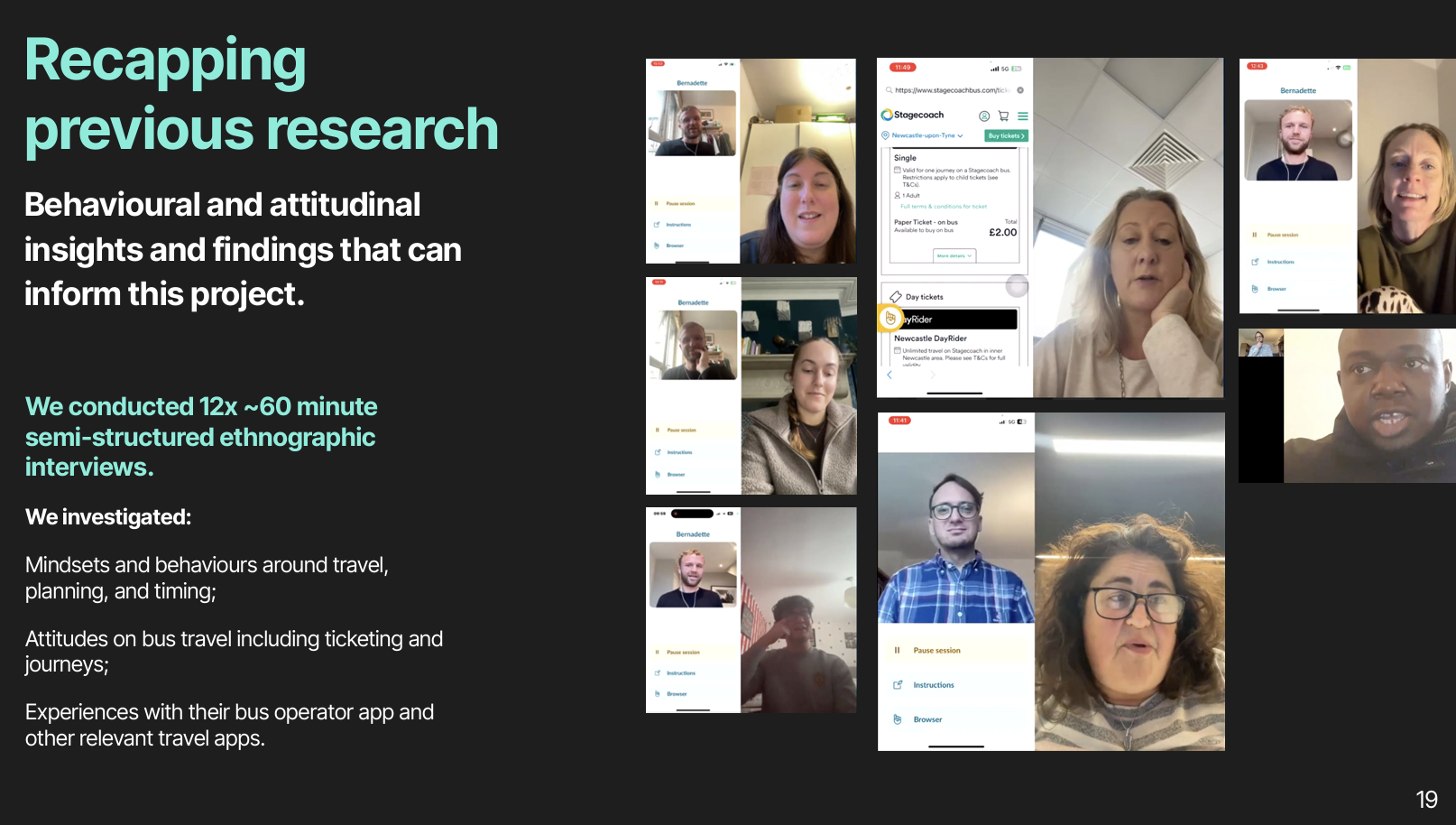
Before touching the brief, we pressure-tested it against six months of existing ethnographic research on how people actually use buses and why they download the app in the first place.
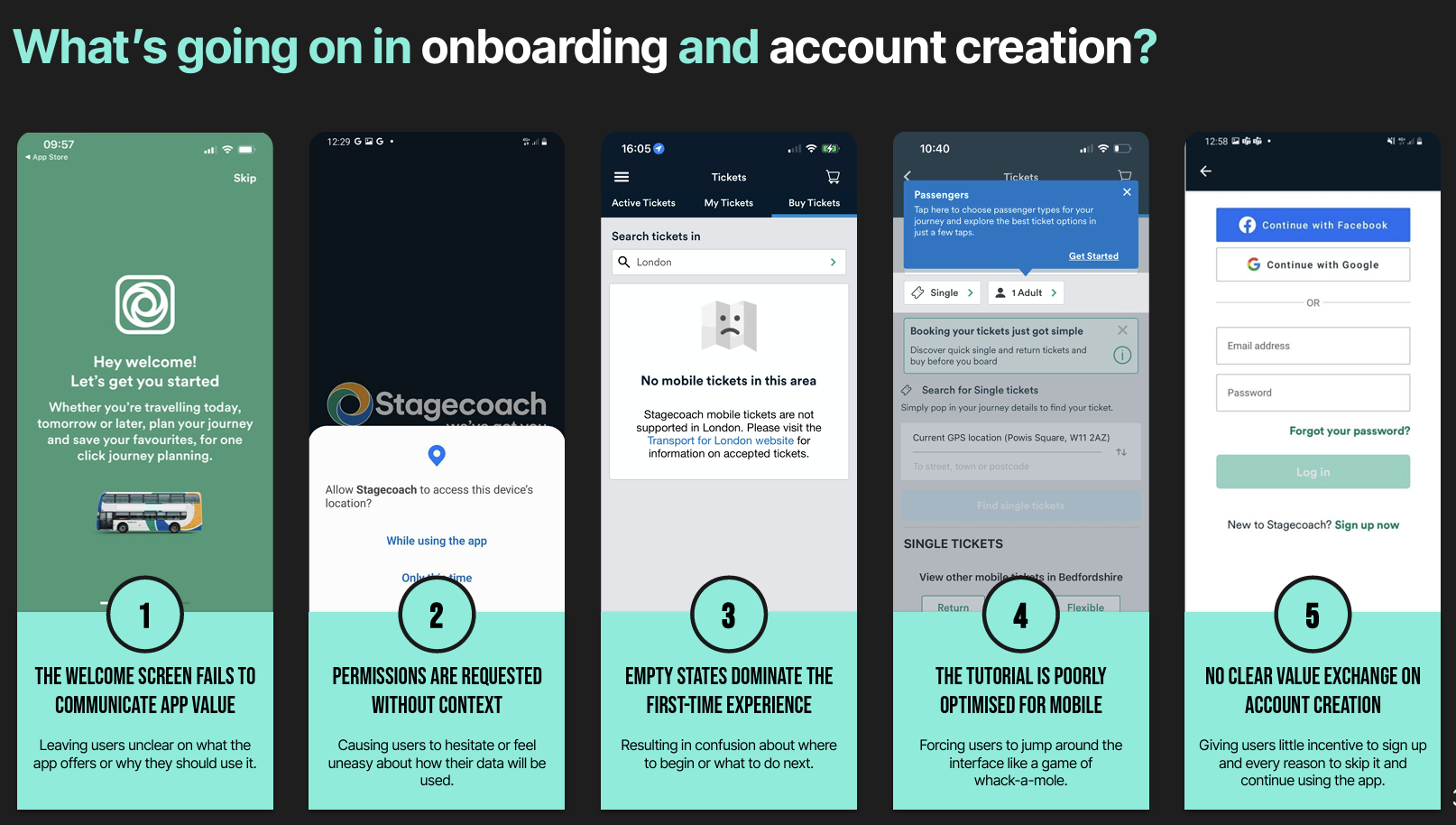
A full UX audit of the existing onboarding flow mapped every friction point, dead end, and missed opportunity before we considered a single new direction.
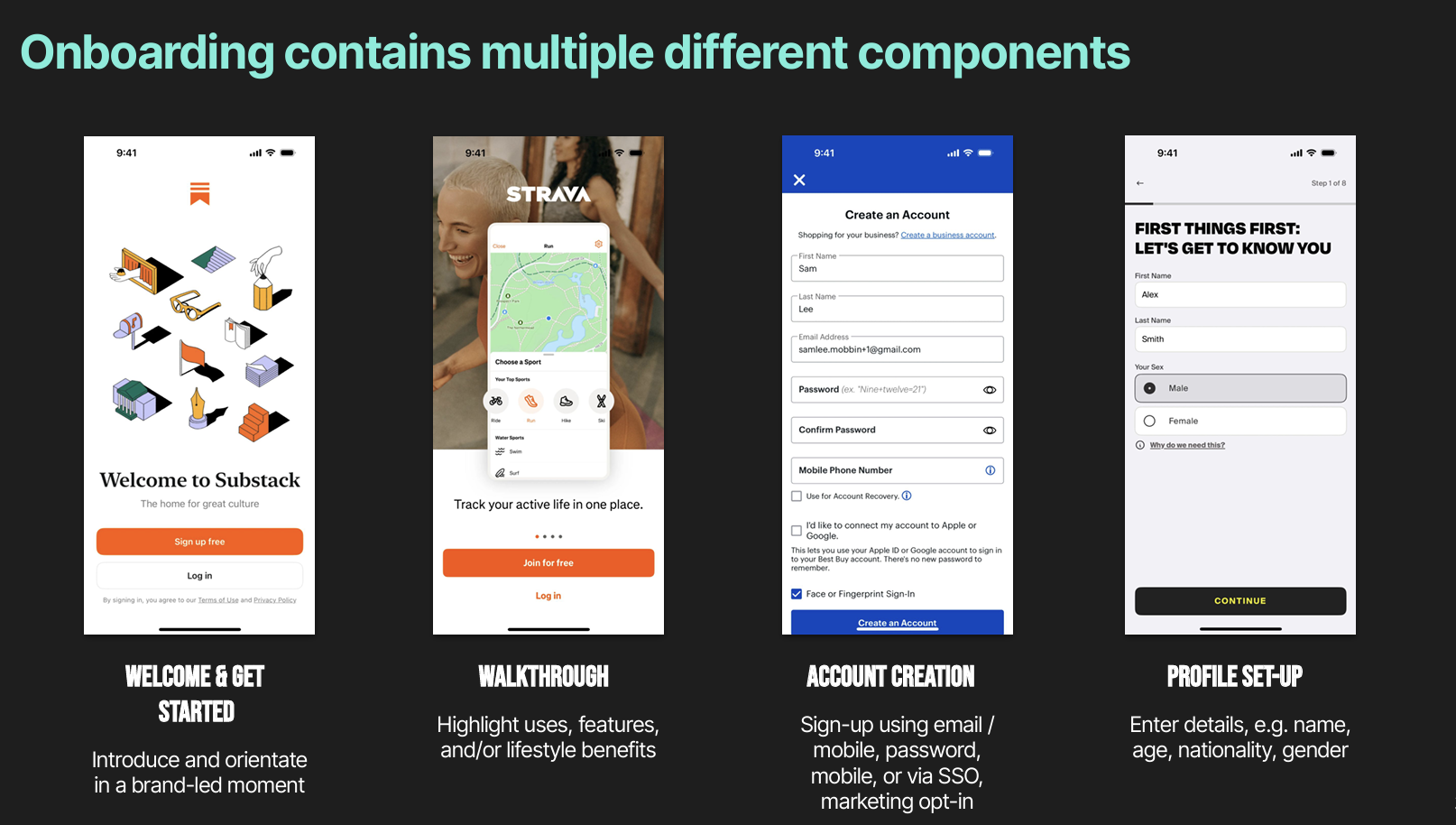
Mapping the eight components of an onboarding experience gave us a common language for evaluating what Stagecoach had, what it was missing, and what it didn't need.
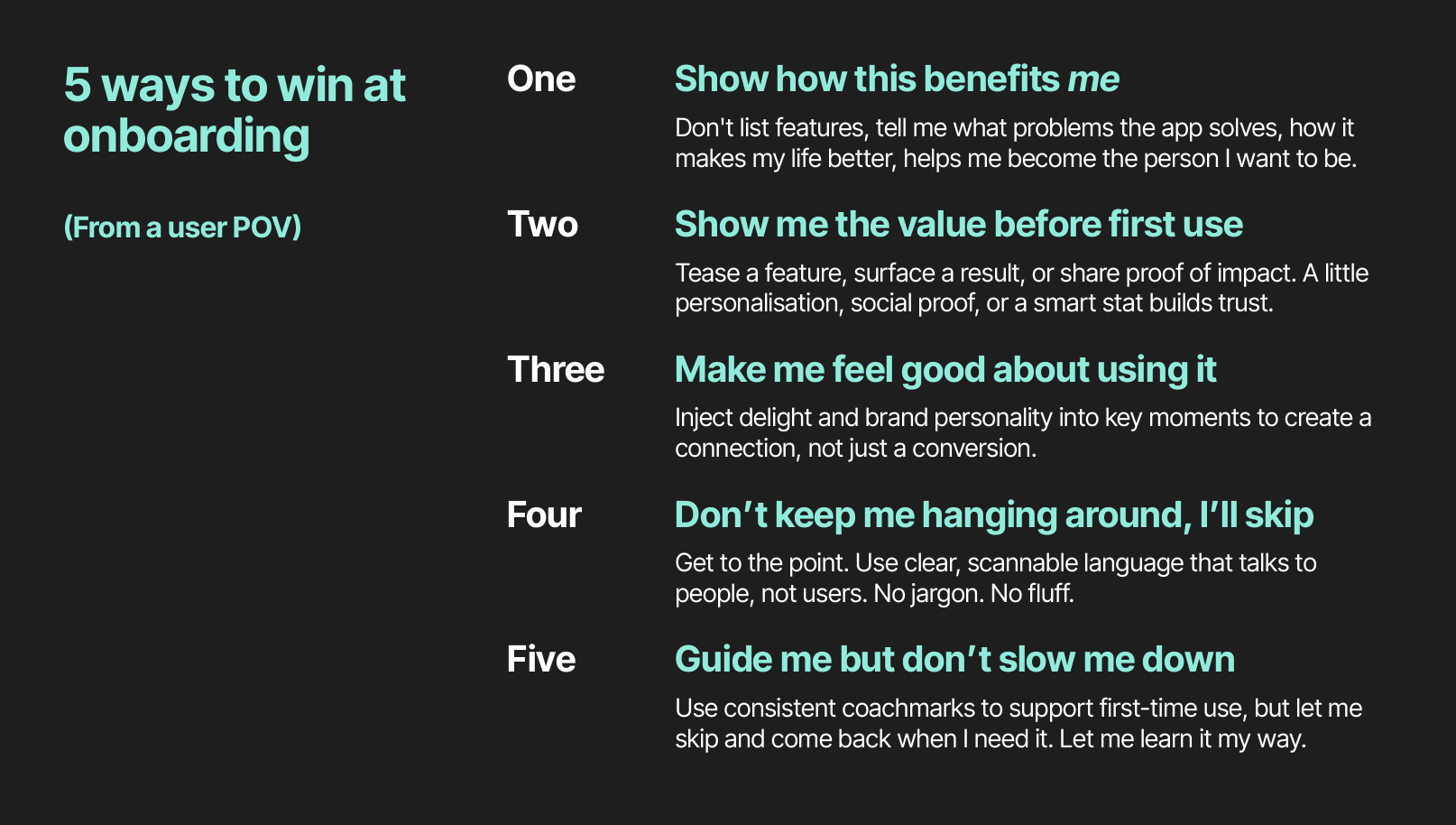
A review of best-in-class onboarding across travel, transport, and beyond produced five clear principles which became the criteria we used to evaluate every direction we took forward.
DEVELOPING THREE ONBOARDING ROUTES
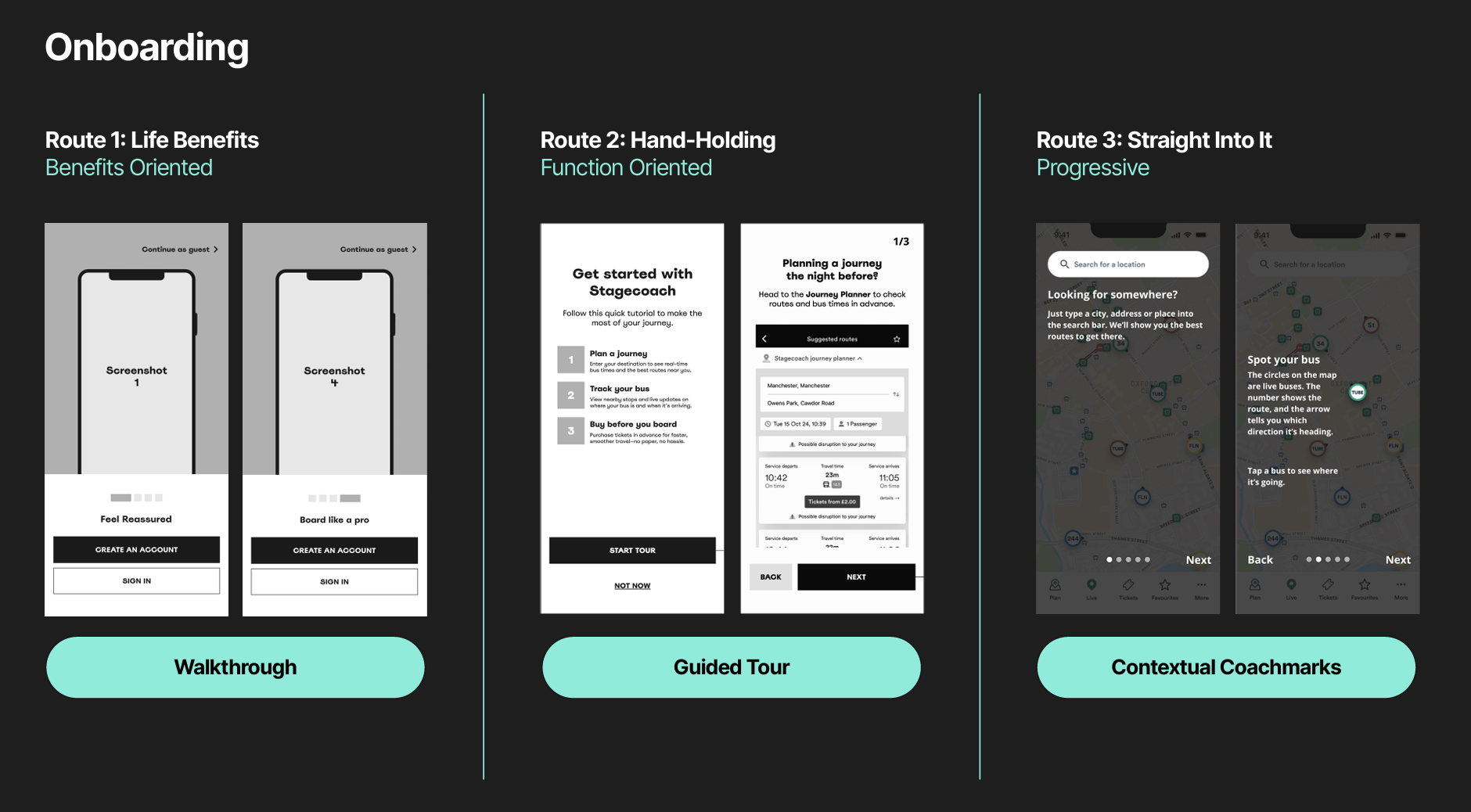
We developed six onboarding directions and converged on three distinct routes, each grounded in a different hypothesis about what drives retention. We then tested these 3 routes to understand which of our hypothesis wer correct.
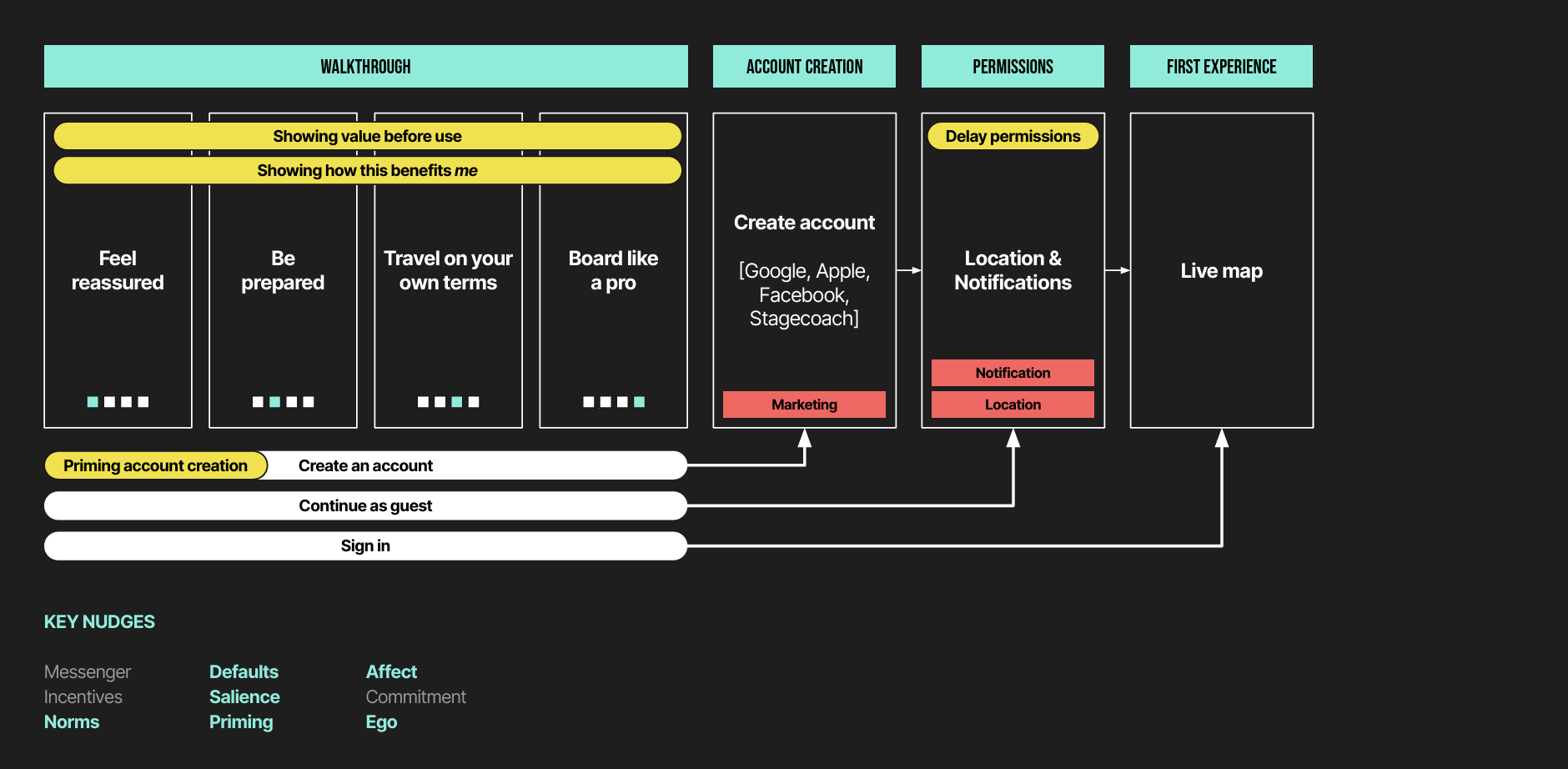
ROUTE 1
Life benefits
Instead of listing functional benefits, lead with how the app can improve daily life. Retention through motivation and ego.
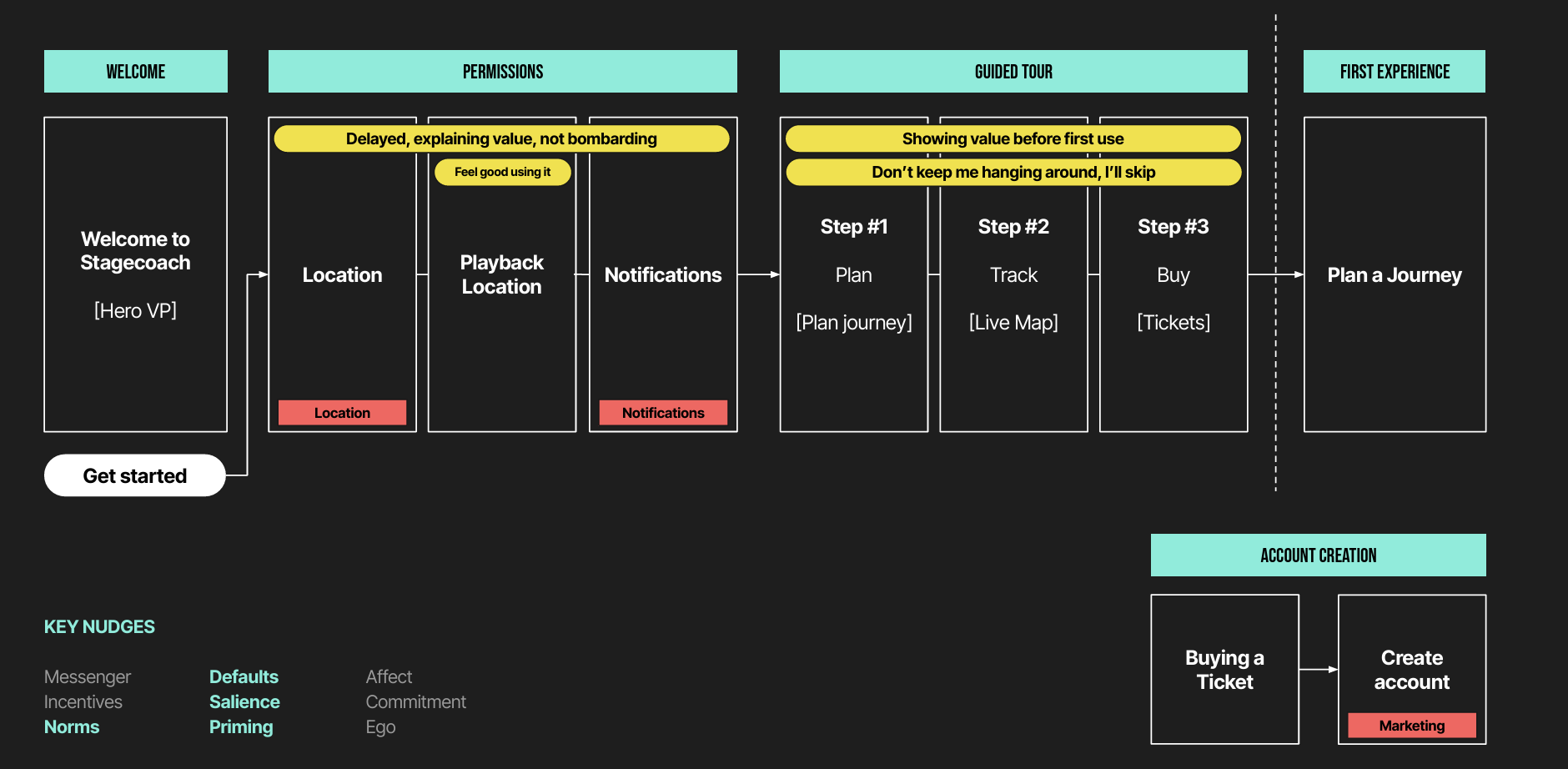
ROUTE 2
Hand-holding
Establish a clear mental model upfront and build retention through confidence and orientation.
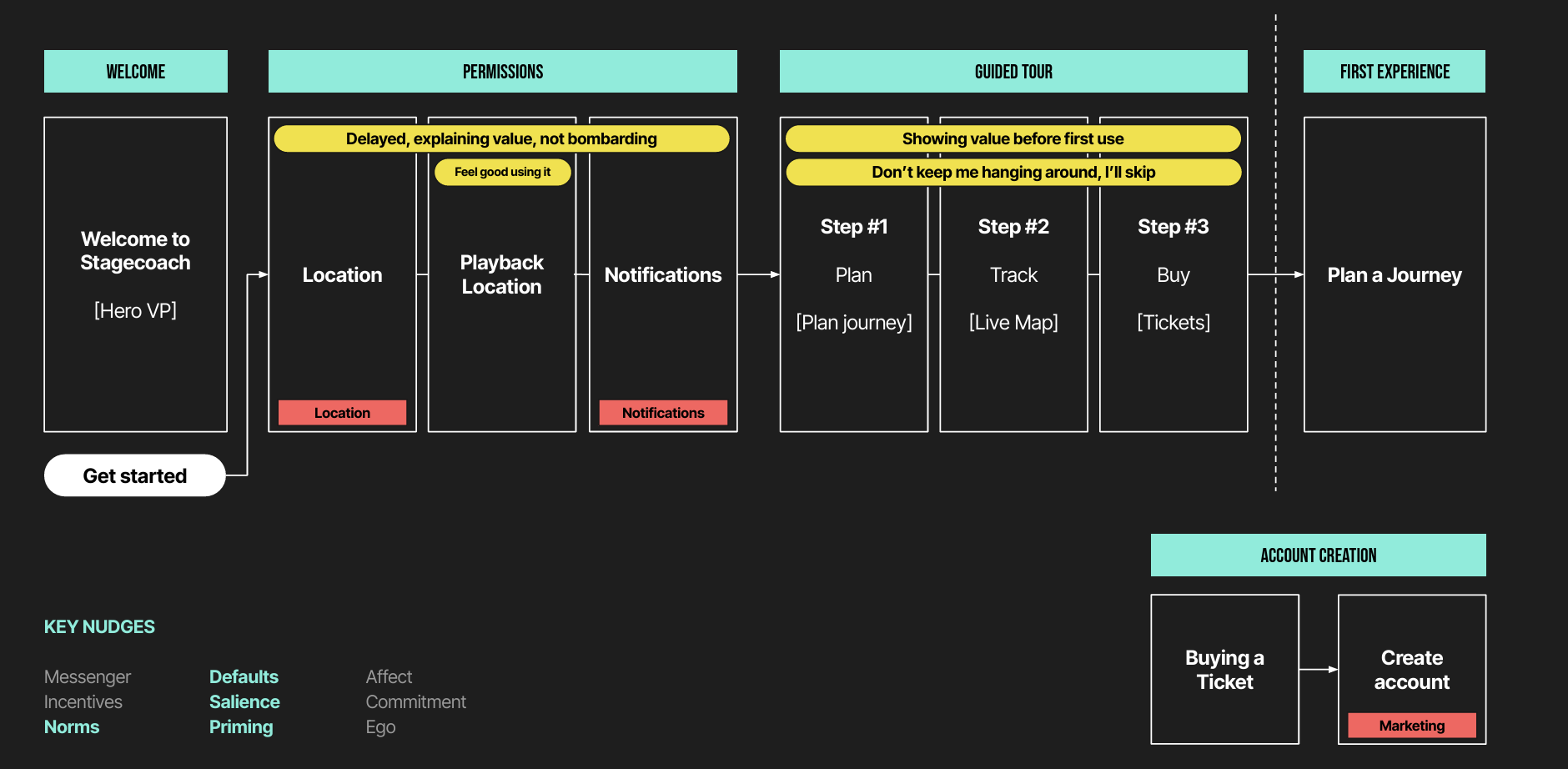
ROUTE 3 ⭐️
Straight into it
Minimise upfront friction and get users to value immediately. Once in the app, layer guidance contextually.
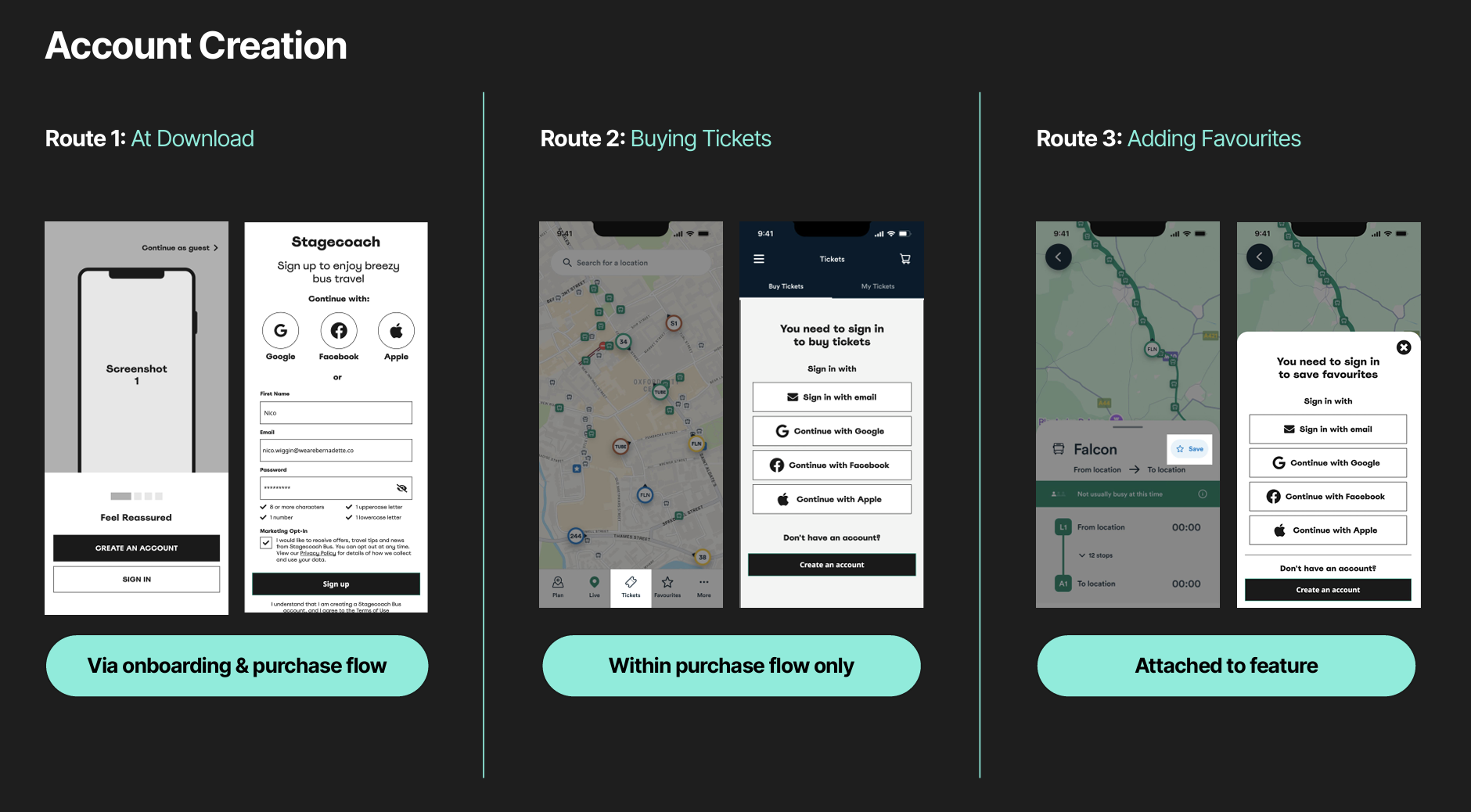
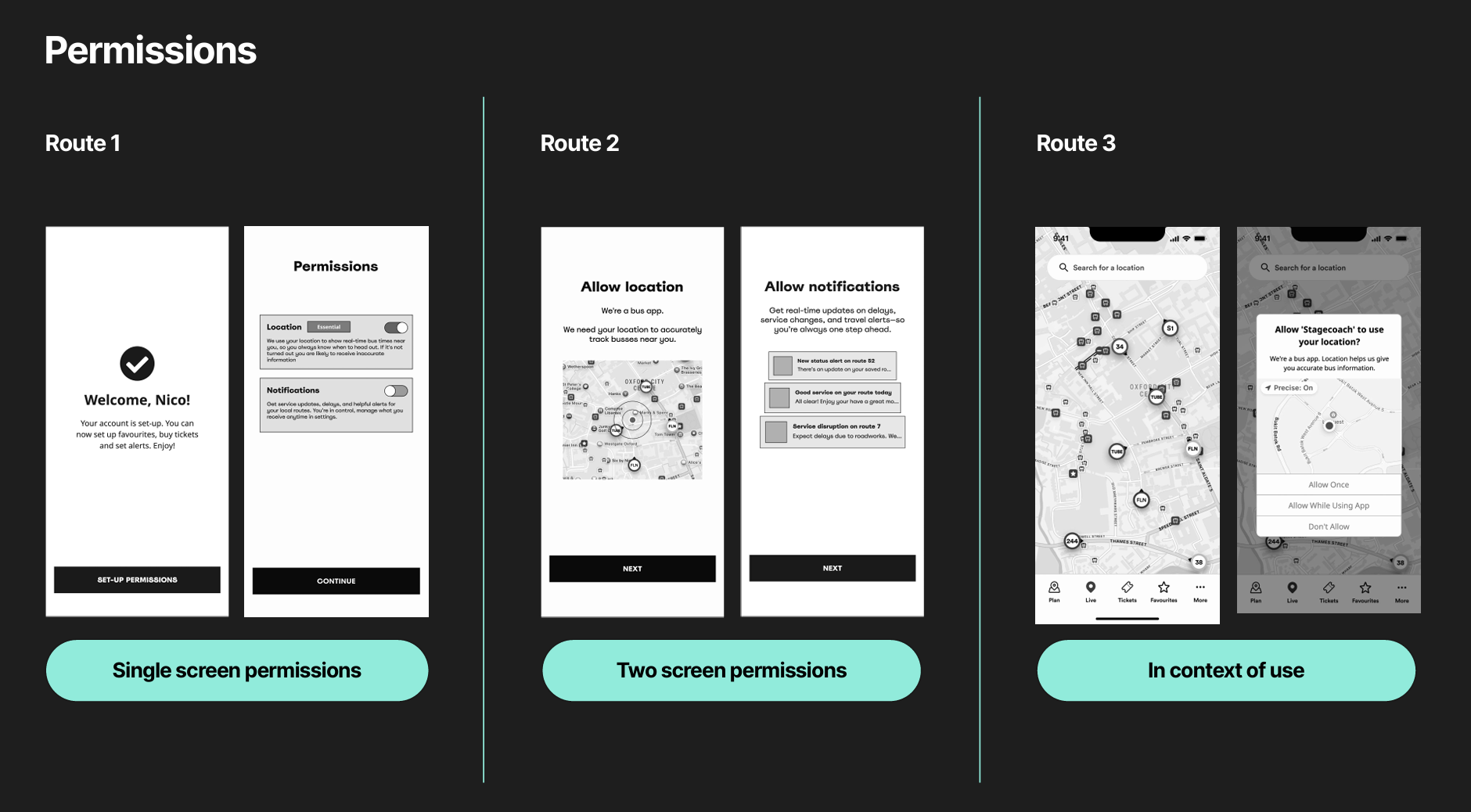
TESTING OUR 3 ROUTES
Testing across six moderated sessions made it clear: users had no appetite to be talked at. They skipped the benefit screens in Route 1 without reading them. The hand-holding in Route 2 felt patronising for a task they already understood. Every participant just wanted to get into the app.
This aligned directly with what we already knew about user context. When someone opens Stagecoach, they have somewhere to be. Optional, dismissible guidance outperformed structured tours in every session. Route 3 wasn't a surprise as it confirmed a hypothesis we already held, and gave us the evidence to align the client behind it.
THE SOLUTION
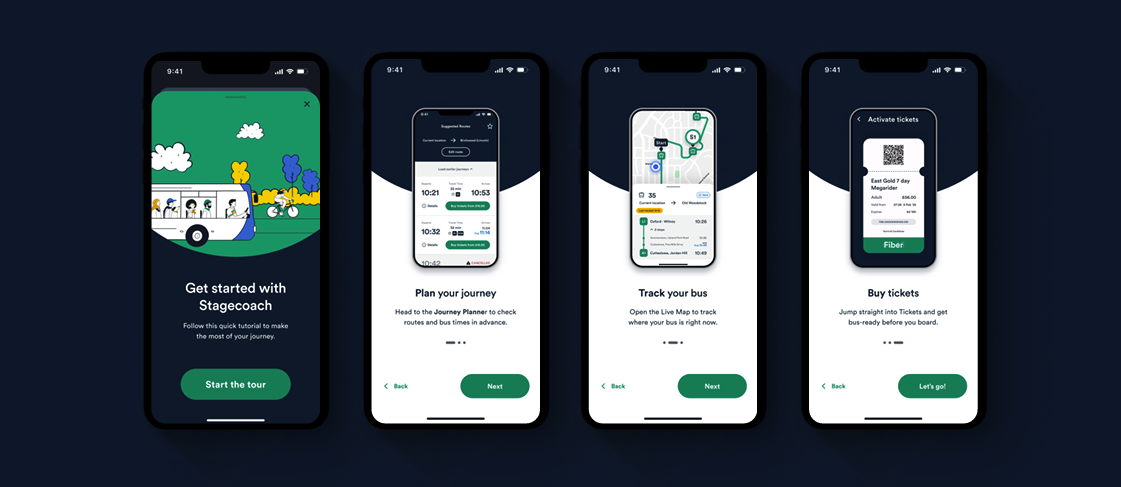
A stripped-back onboarding experience built around three principles:
Frame the experience around the core USP signal of accurate bus times being linked to location permissions and lead with value on every permissions request
Move account creation to post-checkout
Replace structured tours with optional in-app guidance users can access when they choose to.
Each permission request was paired with a clear value exchange, not mundane legal information but a reason for saying yes and how critical it is to a good experience. Location permission triggered an immediate payoff: the user's area surfaced alongside live average wait times, grounding the digital in the physical. A recovery screen for declined permissions reframed the choice rather than creating a dead end.
Account creation moved to the end of the optional guided tour; the moment when a user had already experienced the app's value and the ask had the most context of the value exchange behind it.
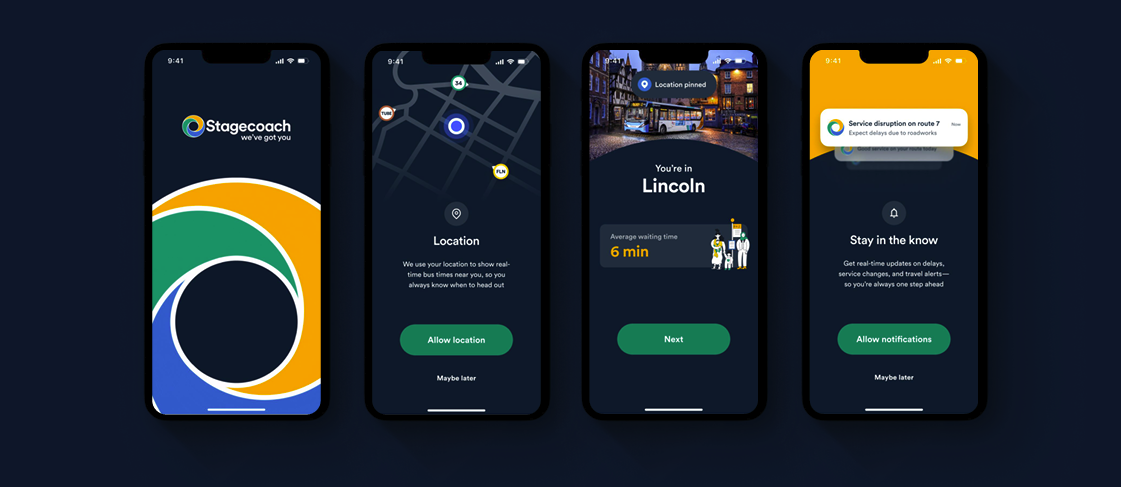
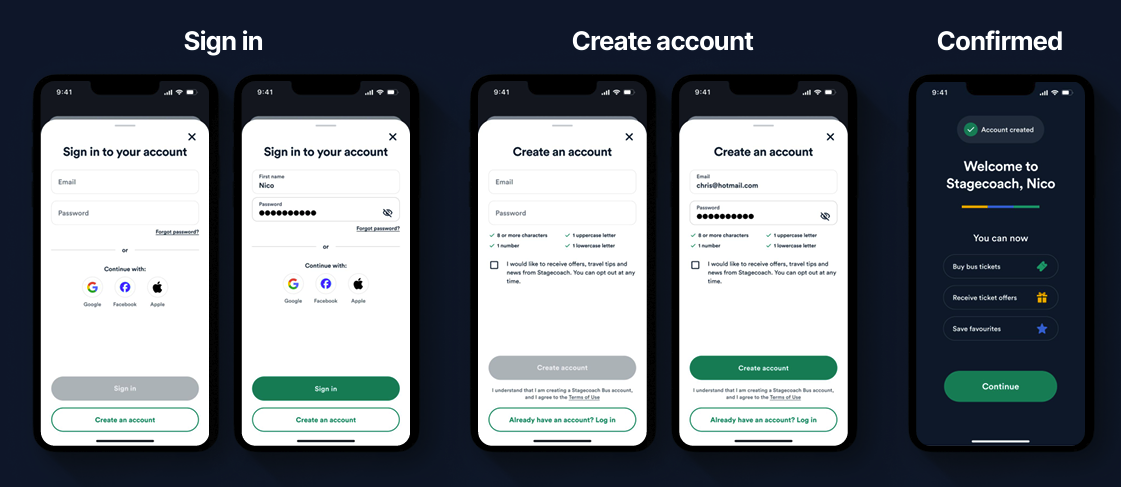
THE DECISION THAT MATTERED THE MOST
We recommended pausing the release. Testing confirmed the new onboarding was clean, fast, and well-received. But usability sessions exposed a harder truth: once users moved past onboarding into the main app, the contrast was jarring. Too many steps, cluttered screens, unintuitive navigation. A polished entry point into a rough product would add dissonance and possibly prove to be a jarring incomplete experience.
My recommendation to the client was to treat this work as a proof of concept; evidence of what the app could feel like and prioritise fixes to the core experience first. Fix journey planning, simplify the purchase flow, reduce the noise. Then reintroduce the onboarding as a genuine reflection of the product behind it.
The client agreed. The designs went into the backlog, sequenced behind improvements to the three core flows: planning, buying, and tracking.
WHAT I’D MEASURE AFTER SHIPPING
Permissions opt-in rate (baseline: ~90% incline on iOS)
Account creation conversion at checkout vs. upfront
Day-7 retention cohorts comparing the new entry flow to the old.