Paula Rosa Kitchens
Turning a B2B Kitchen Manufacturer into a D2C Retailer
A 6-month product strategy and service design project to scope a D2C e-commerce experience for a kitchen manufacturer that had never sold direct to consumers.
Date
May - October 2025
Type
5 month client project
Role
Discovery Research, Product Strategy, Service Design, Competitor Analysis, MVP Scoping
Platform
Web (e-commerce)
Tools
Lookback, Askable, Miro, Claude, NotebookLM, GSuite
Problem
Paula Rosa Kitchens are a B2B kitchen manufacturer supplying residential developers and new-build contractors at scale. Their entire operation; order management, manufacturing, customer service was built for bulk B2B orders.
They wanted to go direct to consumer but they had no website, no consumer-facing product catalogue, and no operational infrastructure to support it.
Task
Figure out whether a D2C model was operationally viable for Paula Rosa and if so, what an MVP would need to look like to get them to market.
That meant understanding the existing business inside out before designing anything. Running stakeholder and customer discovery, mapping the full service blueprint, auditing the competition, and scoping a prioritised MVP in collaboration with the tech team.
Solution
A fully evidenced MVP proposition; scoped, sized, and prioritised built on three pieces of foundational work:
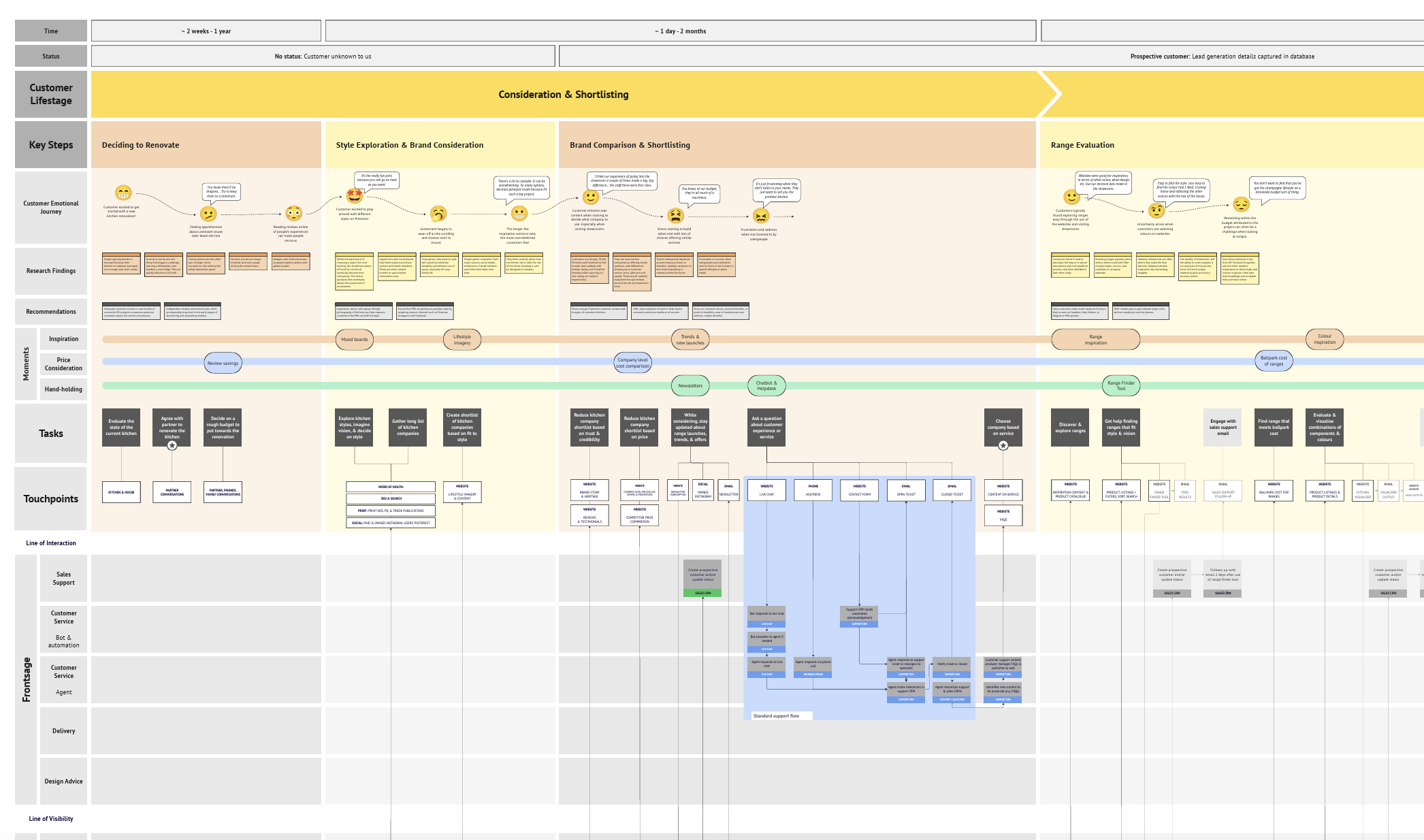
A service blueprint mapping how Paula Rosa's existing operations would need to adapt to support D2C fulfilment, from order processing to last-mile delivery to consumer CRM.
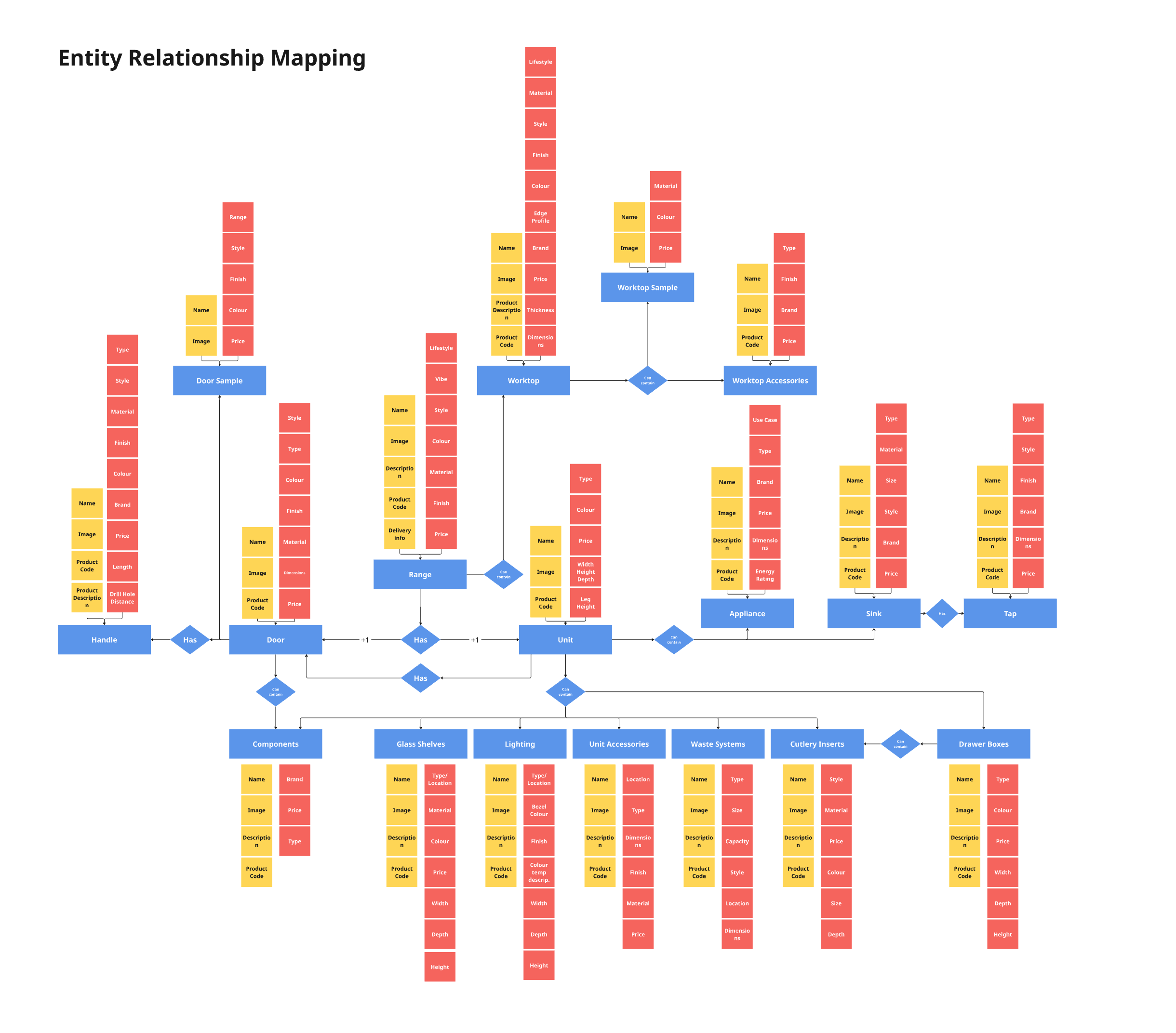
A new product data architecture using OOUX and entity relationship mapping to model the catalogue structure the MVP would run on.
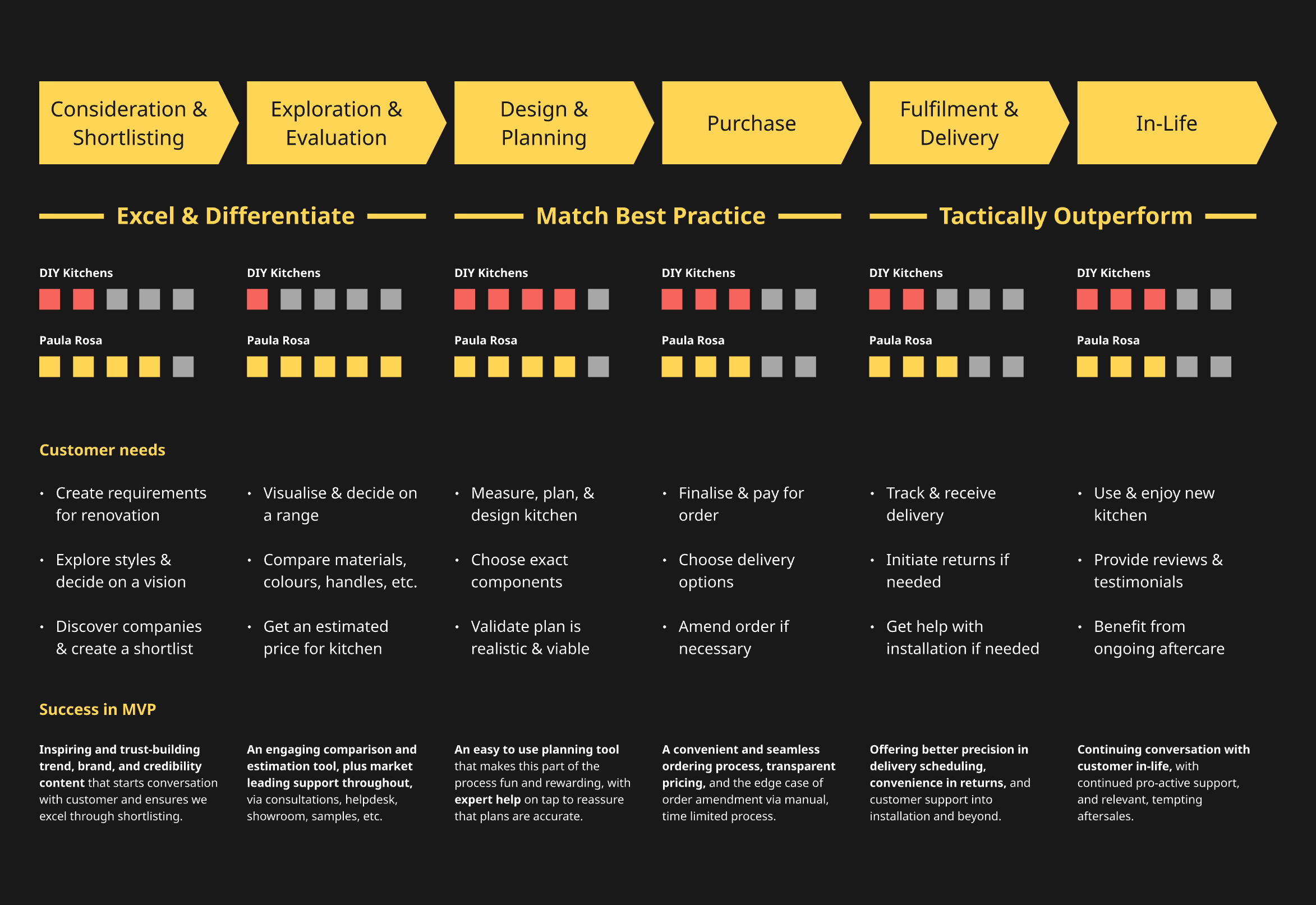
An MVP scope defined using three prioritisation principles, written as Jira tickets, sized by the tech partner, and structured around a key differentiator: an early lifecycle tool to reduce choice paralysis and bridge the gap between browsing and planning.
My Role
I was the sole UX Designer on the project, working day-to-day alongside Mattie Alston, a strategist. A project manager handled delivery oversight and our Chief Strategy Officer provided senior direction, though the core work was driven by Mattie and me as a two-person team.
I led:
Service blueprint design - translating discovery outputs into a recommended operational and service model
Competitor UX audit across five retailers, used directly to define MVP feature scope
Product data audit, OOUX mapping, and entity relationship modelling - establishing the data architecture the MVP would need to run on
I co-owned with Mattie:
Research planning and customer interview execution (12 interviews via Askable)
Research synthesis and reporting
User story mapping, Jira ticket writing, and MVP scoping. I sized design effort per feature and led the deprioritisation rationale.
The MVP and Enhanced MVP proposition
I supported:
Stakeholder interview sessions (Mattie led, I attended and we synthesised findings)
Strategic vision development
If you want to read more and see my process, check out the full story below…
Who are Paula Rosa Kitchens?
Paula Rosa Kitchens are a mid-range kitchen manufacturer based in the UK. Their bread and butter is supplying kitchens at volume to residential developers; think new-build housing estates and large apartment blocks. Same style, same spec, 50 units at a time.
It's a solid B2B model. But it's about as far from individual consumer retail as you can get.
The D2C kitchen market had been growing fast. DIY Kitchens had proven that customers would plan, configure, and buy a kitchen entirely online, no showroom, no salesperson, just a website, a planning tool, and a delivery date. Paula Rosa had the manufacturing capability to compete. What they didn't have was anything else.
Discovery
Stakeholder Interviews
My first decision was to sequence discovery deliberately: map Paula Rosa's existing operations before speaking to customers. If we understood what the business could actually support, we could design a D2C service that optimised the existing model rather than rebuilt it. Going to customers first would have generated an idealised experience brief that Paula Rosa's operations couldn't fulfil.
We expected reasonably mature internal systems. What we found was almost entirely manual.
Seven operational gaps with direct implications for D2C viability:
Manual order processing
Fulfilment ran on bespoke legacy tools requiring individual data entry. Error rates were a big problem at B2B volumes. D2C would require web automation.
No digital support layer
Customer service ran entirely through phone agents. No self-service, no CRM, no automated handling. Not viable at consumer volumes.
Fragmented Systems
Multiple disconnected tools functioned adequately for repeat bulk orders but couldn't handle varied individual consumer orders. Nothing talked to anything else.
Third-party worktop fulfilment
Worktops arrived on separate lead times from cabinets. No process existed for managing split deliveries to consumer addresses. An unresolved gap before launch.
Product data built for internal use
Inventory used internal codes with no consumer-facing naming. The entire catalogue needed restructuring before it could go live.
Last-mile delivery
Standard vehicles were sized for building sites, not residential streets. A third-party last-mile partner or revised delivery model was required.
Customer Interviews
We ran 12 in-depth interviews with recent kitchen buyers across DIY Kitchens, Howdens, Magnet, IKEA, B&Q and Wren - covering the full journey from deciding to renovate through to in-life ownership. Three findings directly shaped the MVP.
Choice paralysis was a big barrier to purchase
The early stages of the kitchen journey; choosing a style, exploring ranges, narrowing down a company were described as simultaneously exciting and overwhelming. Customers had abundant inspiration but no easy way to convert it into confidence. Several delayed starting entirely because the jump from "browsing" to "planning" felt too large.
Drove → Early lifecycle tool: Style explorer + ballpark pricing before planner
“There’s a lot to consider. It can be overwhelming. So many options, decision paralysis mode because it’s such a big project. You really want it to be perfect. You want to make sure you can make the decisions.”
Trust is often won before anyone visits the website
Customers validated every company through reviews, real customer photos, and word of mouth before engaging seriously. They were skeptical of polished marketing and sought out unfiltered evidence: TrustPilot 3-4 star reviews specifically, because they felt more honest than 5-star ratings. For a brand with no consumer track record, this was a significant barrier to entry.
Drove → customer stories, real kitchen photography, and Trustpilot integration in MVP
“I felt a bit nervous because I’ve seen a few people on social media... And they seem to have quite a few problems when they start renovating their kitchen.”
The planning tool was a source of real anxiety
Even customers who successfully used online planning tools described them as daunting. Measuring accurately, visualising layouts in real space, and understanding viable configurations were all significant pain points. Most leaned on builders, family members, or workarounds like felt cut-outs to bridge the gap. Dropping customers directly into a complex planner without preparation would increase abandonment.
Reinforced → early lifecycle tool as a bridge - lightweight and fun before the complexity
““The layout of the empty room was the hardest part for me by far. I just felt like I was being a bit dense.”
The Service Blueprint: translating discovery into a viable service
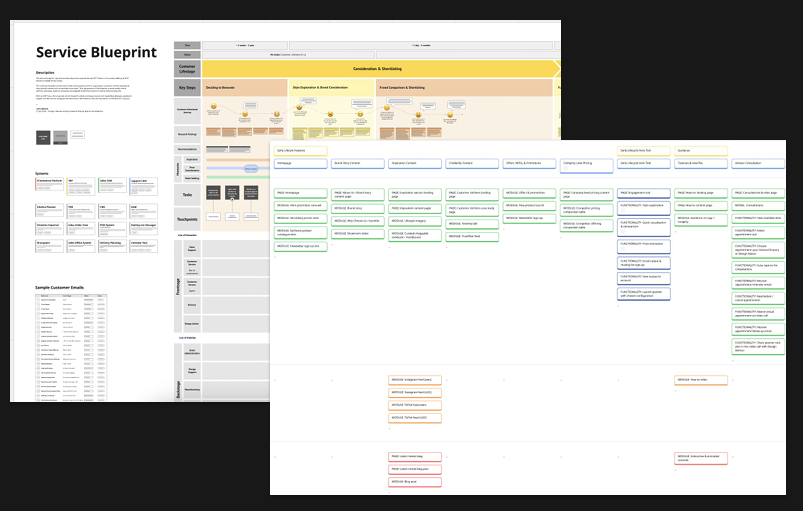
The service blueprint translated discovery outputs into a single, end-to-end view of how Paula Rosa would need to operate as a D2C business, mapping customer touchpoints against the internal processes, roles, and systems required to fulfil them at each stage.
Its primary value wasn't necessarily revelatory, it was more validation by giving internal operations and the IT team a shared, concrete picture of what needed to change and in what sequence.
Four areas surfaced as most significant:
Returns
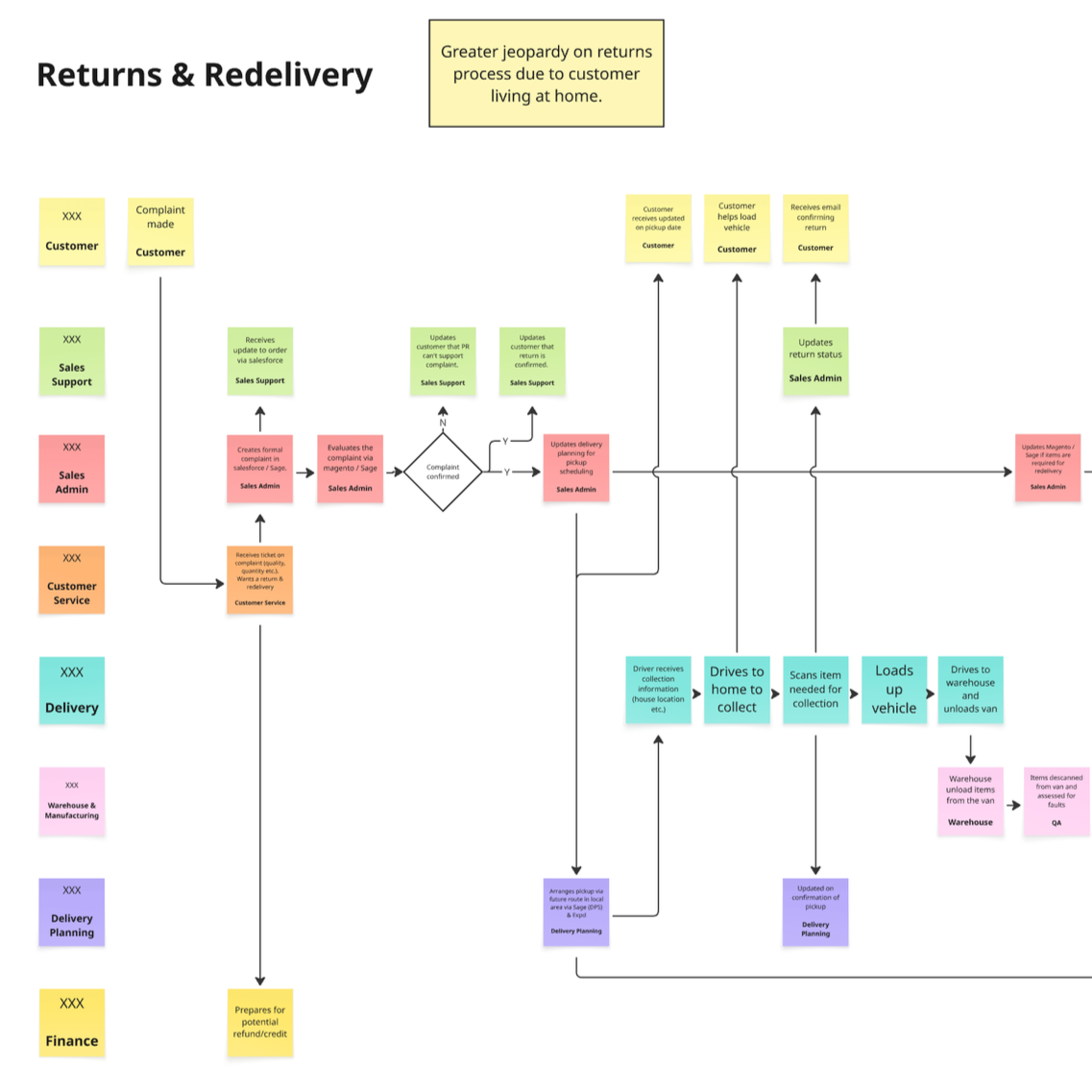
B2B returns could take 1–2 weeks without issue. A consumer waiting with two loose cabinet doors in a half-finished kitchen is a different problem. We designed a returns flow within the support CRM that would trigger a replacement order simultaneously in the e-commerce platform and ERP, automatically generating a redelivery and collection request to the last-mile provider. One customer action, one automated chain, no manual intervention.
Samples and last-mile delivery
The existing delivery model; large vehicles and building site logistics weren’t designed for residential addresses or small parcel returns. Getting samples to consumers quickly exposed an immediate gap. We recommended a third-party last-mile partner to handle flexible deliveries and returns.
Role repurposing
Internal roles had been built around B2B account management, deep product specialists helping developers configure large orders. D2C required generalist customer agents able to handle a consumer's quick query over chat or phone. Several roles needed redefining, not just retraining.
Consumer CRM & lifecycle communications
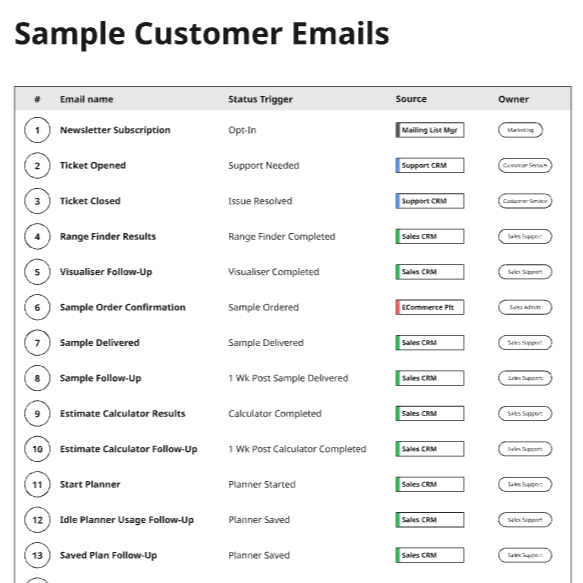
Mapping the full customer communication timeline revealed that Paula Rosa had no email notification or CRM strategy for consumer lifecycle marketing. The blueprint became the foundation for the marketing team's communication plan - a deliverable that hadn't been scoped at the start of the project.
Evolution of the Service Blueprint
-
![]()
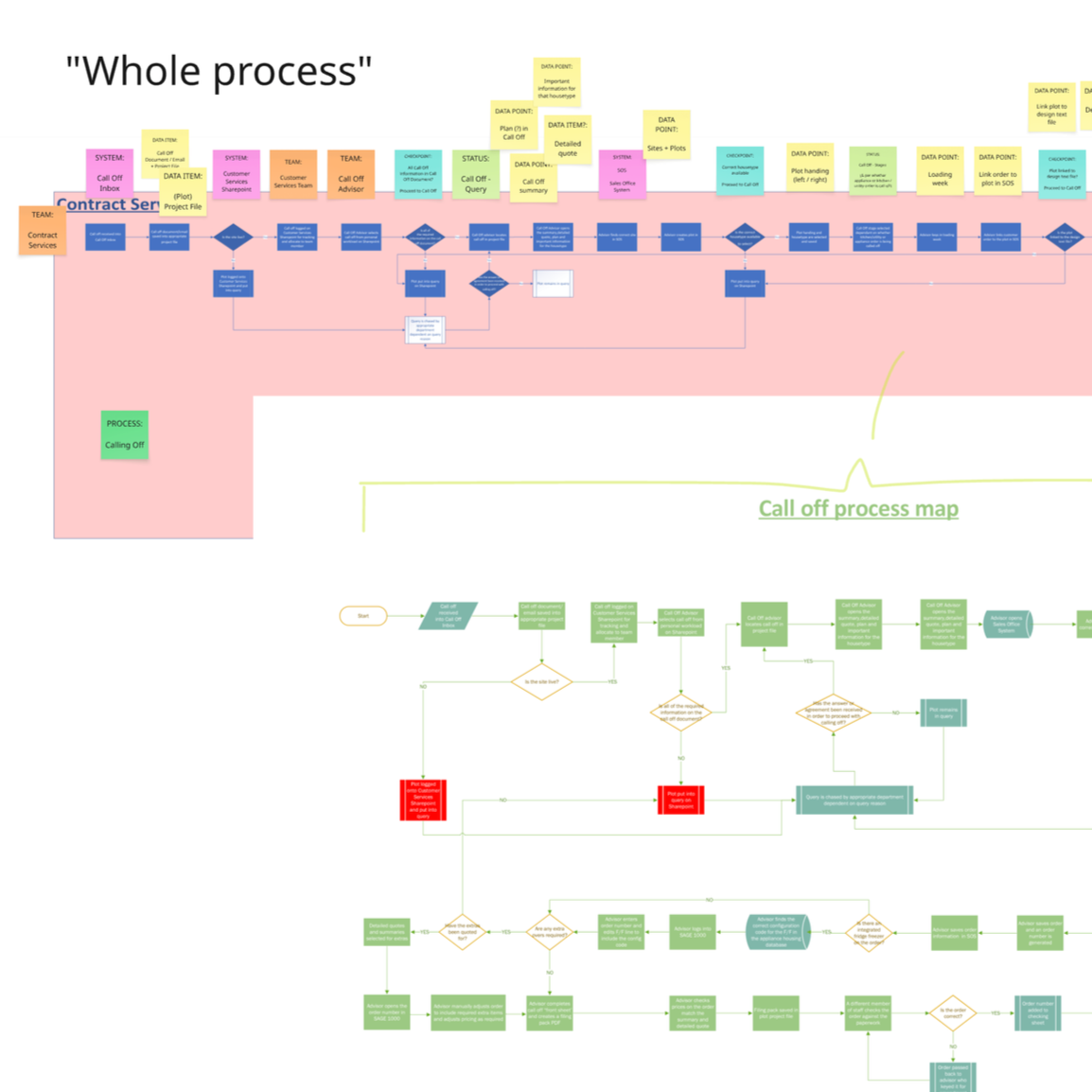
01 Reviewing Existing Processes
We started by reviewing a set of existing process flows from Paula Rosa, building a clear picture of how their internal operations had run up to that point.
-
![]()
02 Mapping a Draft Service
Our first cut at a D2C service model, adapting and optimising Paula Rosa's existing processes to work in a consumer context rather than rebuilding from scratch.
-
![]()
03 Customer Meets Service via the Website
Zooming in on the key touchpoints where the customer first encounters the service. The moments where the digital experience and the operational reality had to connect.
-
![]()
04 Deep-Diving into Returns & Redelivery
Returns and redelivery had to be redesigned from scratch. This diagram goes deeper into that specific flow, detailing how a consumer return would trigger a replacement and collection through the last-mile provider.
-
![]()
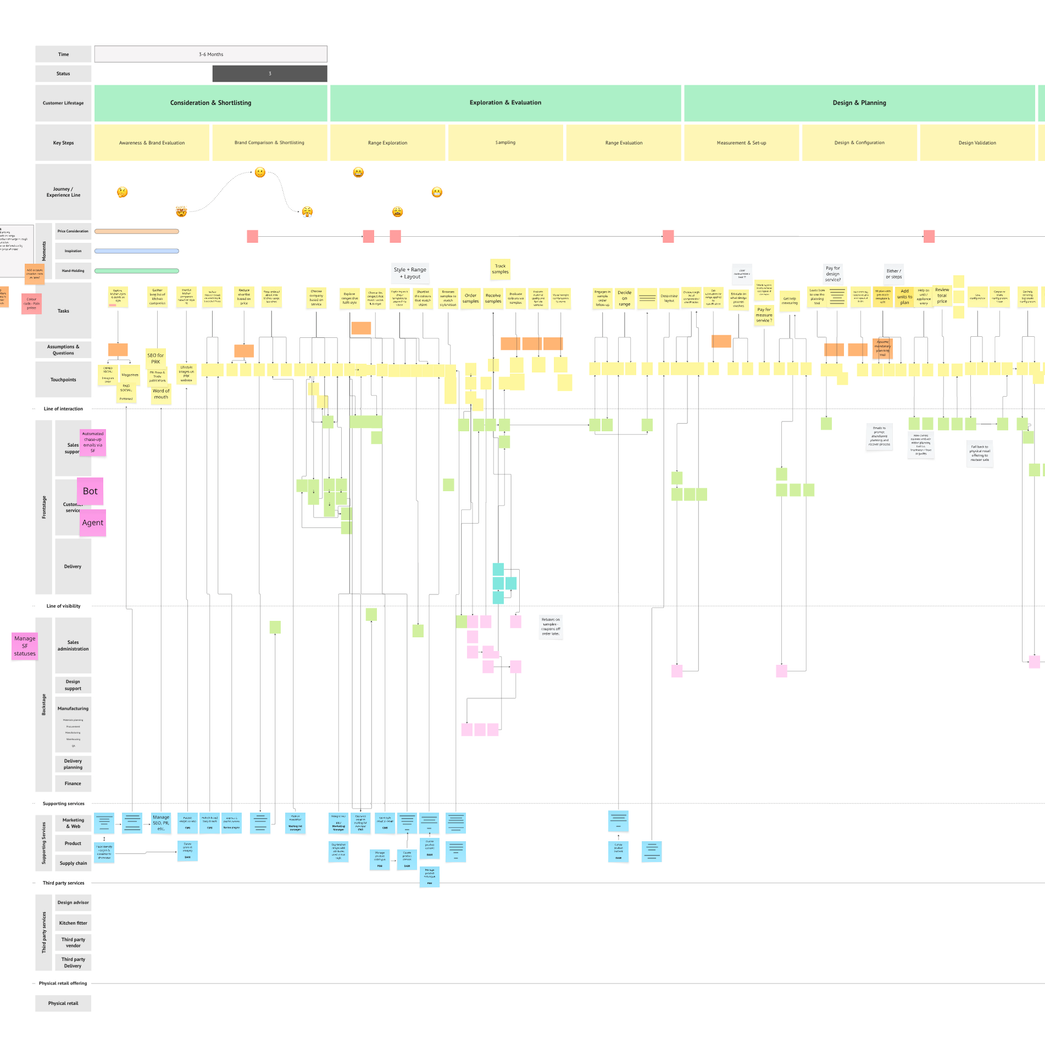
05 The Final Blueprint
The finished article. As well as mapping the full service, we brought visual design into the blueprint itself making it easier to read, present, and hand over to the client.
-
![]()
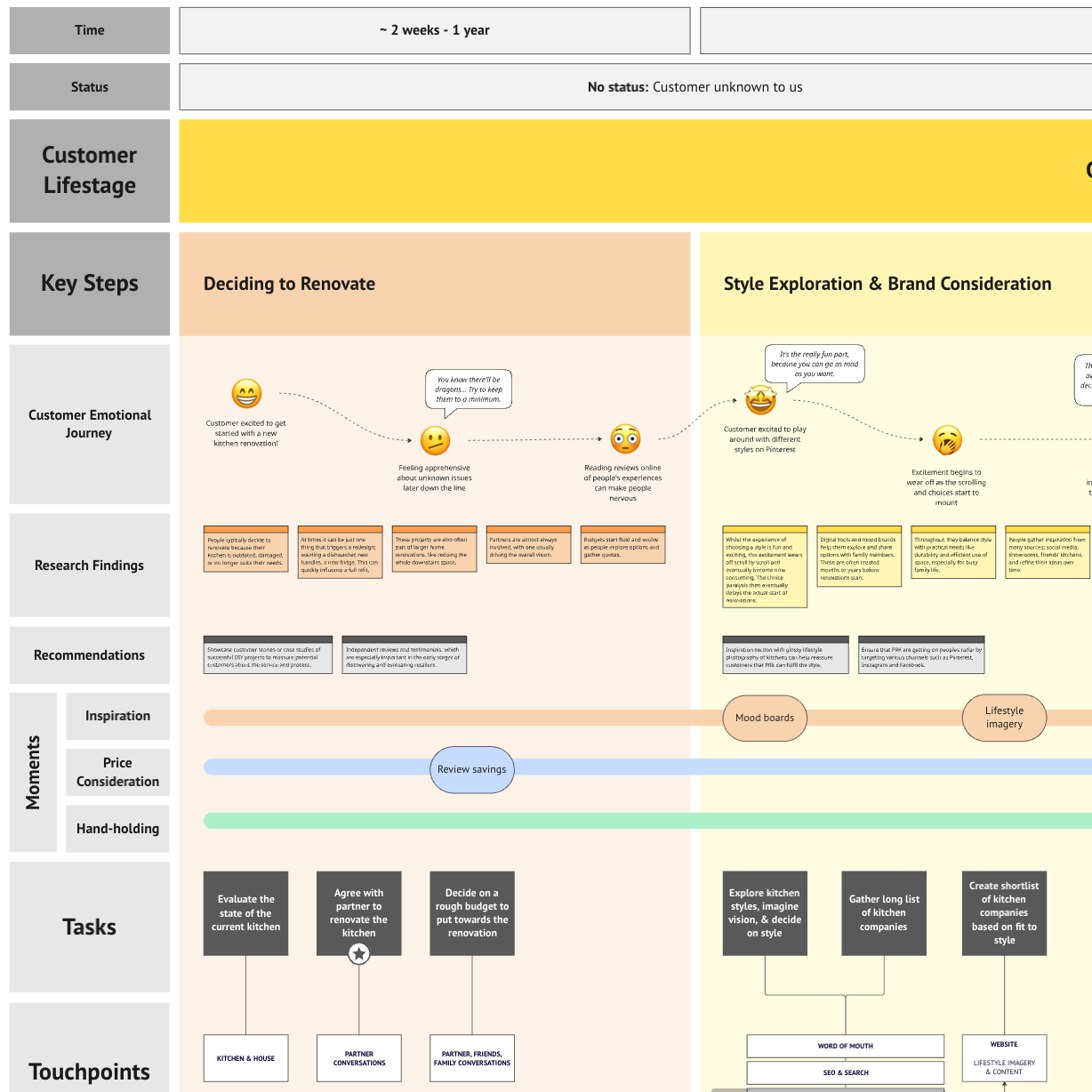
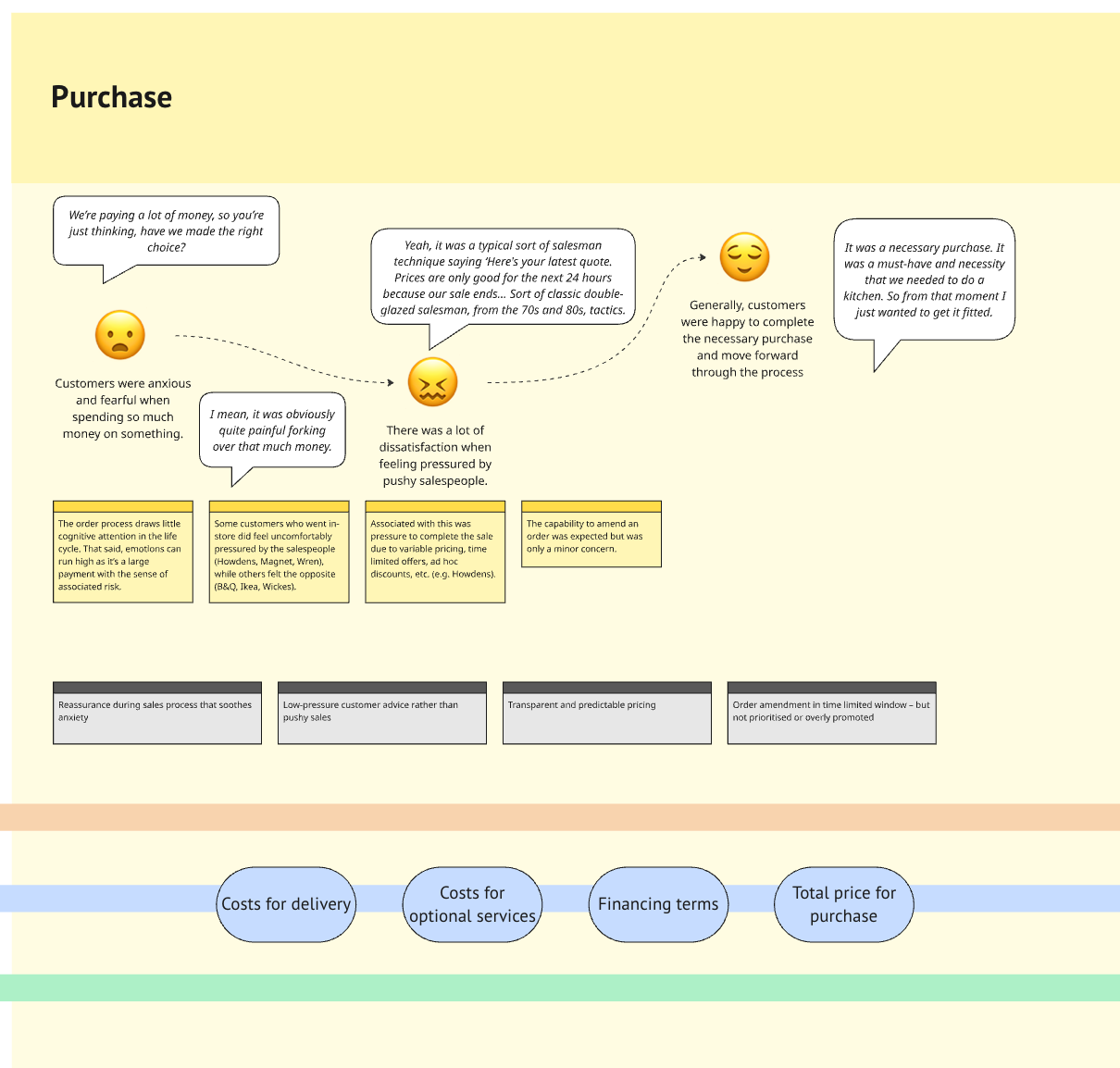
06 Bringing in Customer Research
In the top section of the blueprint we overlaid findings from the customer interviews, connecting what people actually experienced with the service that would need to support them.
-
![]()
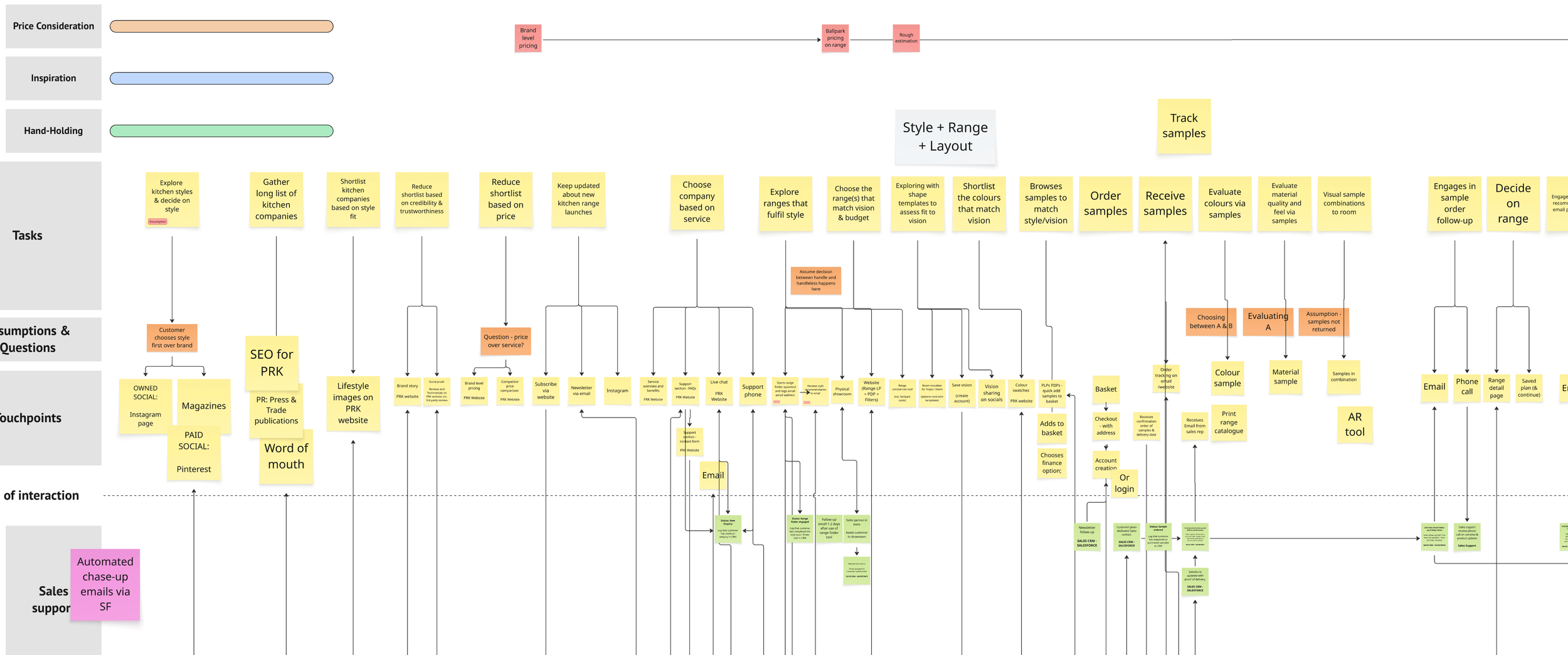
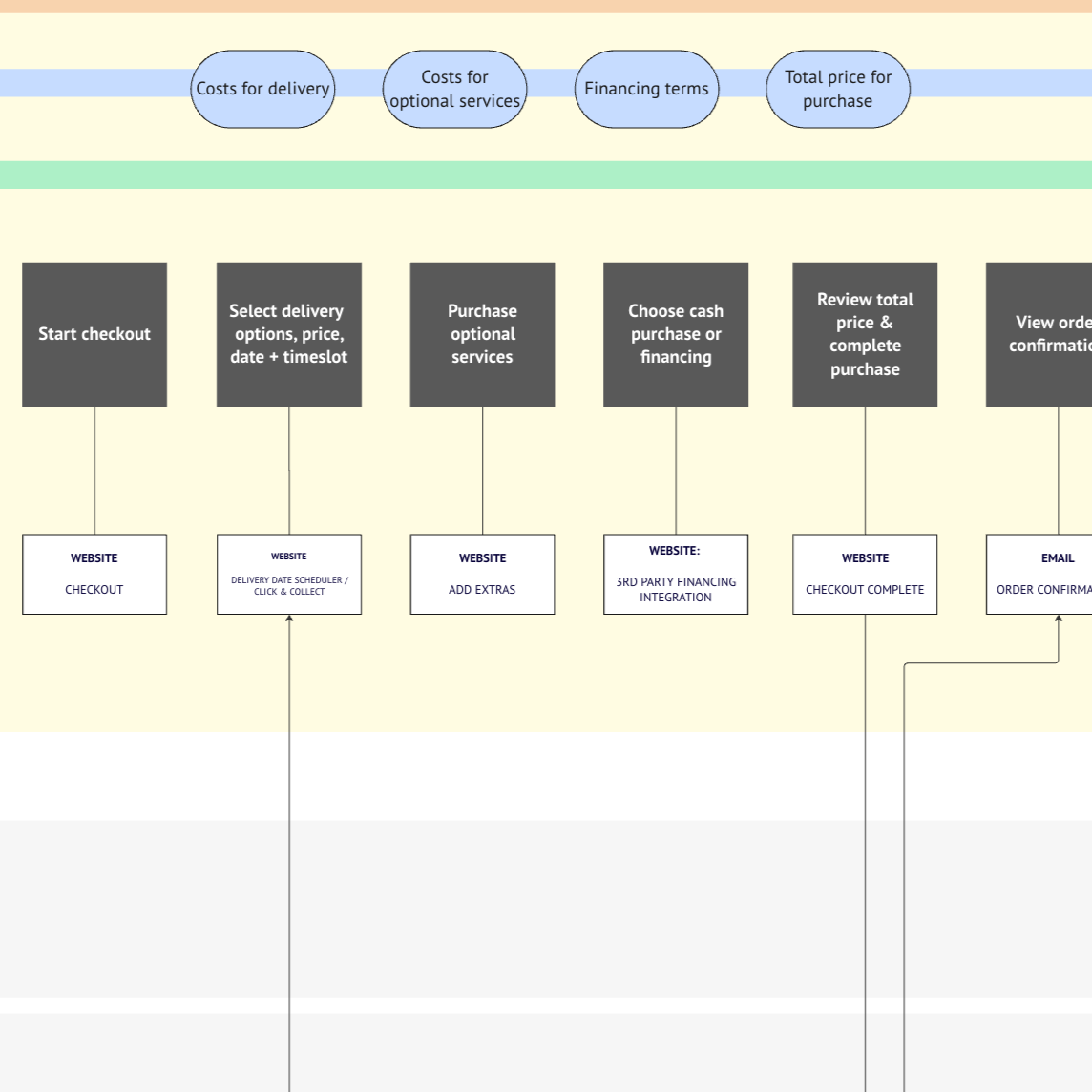
07 Customer Actions & Web Touchpoints
Zooming in on the customer facing layer, the steps a consumer would take and the web touchpoints they'd interact with at each stage of the journey.
-
![]()
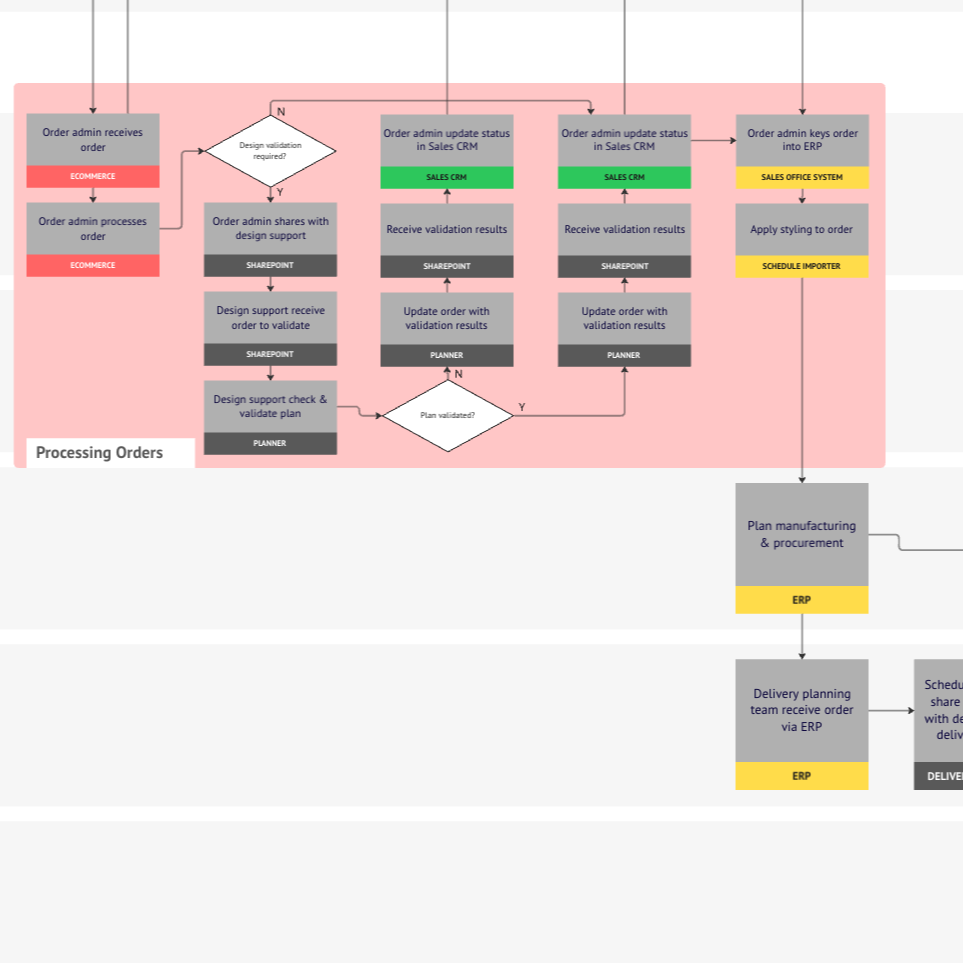
08 Mapping the Flows Between Systems
A closer look at how orders moved through the business, detailing the interactions between the e-commerce platform, Sales CRM, and supporting internal tools.
-
![]()
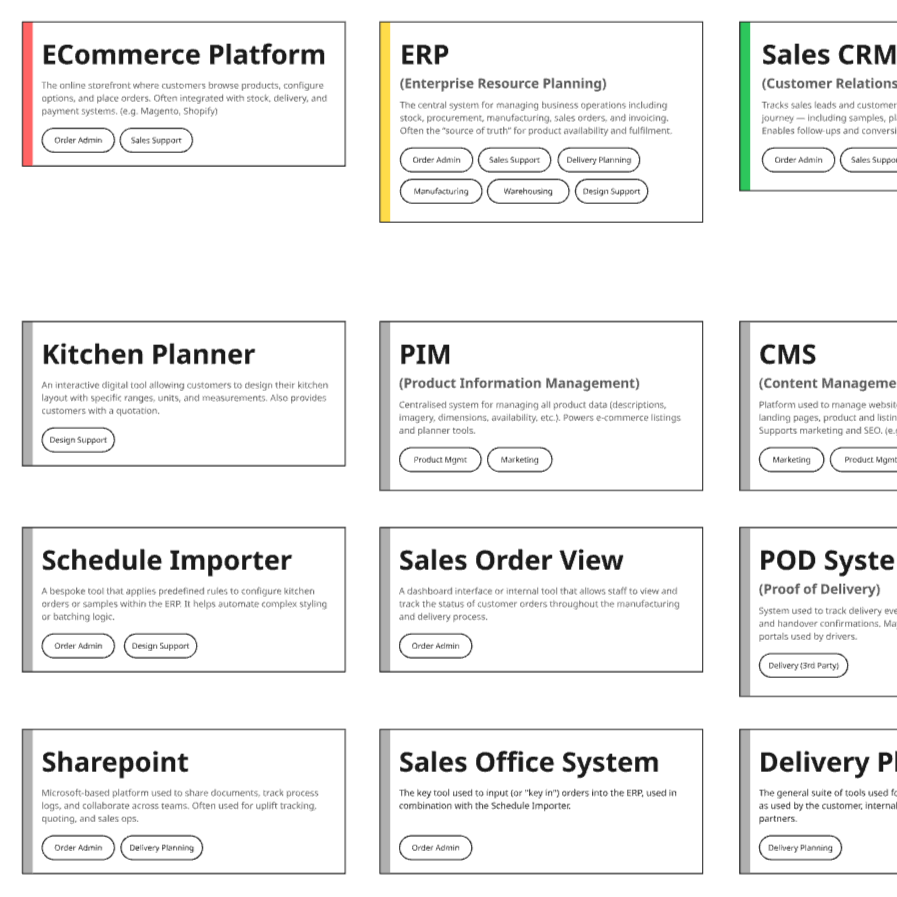
09 Detailing the Core & Secondary Systems
In the blueprint introduction, we catalogued all the systems involved in delivering the service; core platforms and the secondary tools that supported them.
-
![]()
10 A Customer Communication Strategy
An unexpected deliverable. Mapping the full customer journey revealed there was no existing CRM or notification strategy for consumer communications. The blueprint became the foundation for one.
Competitor Audit & Product Data - Informing the MVP
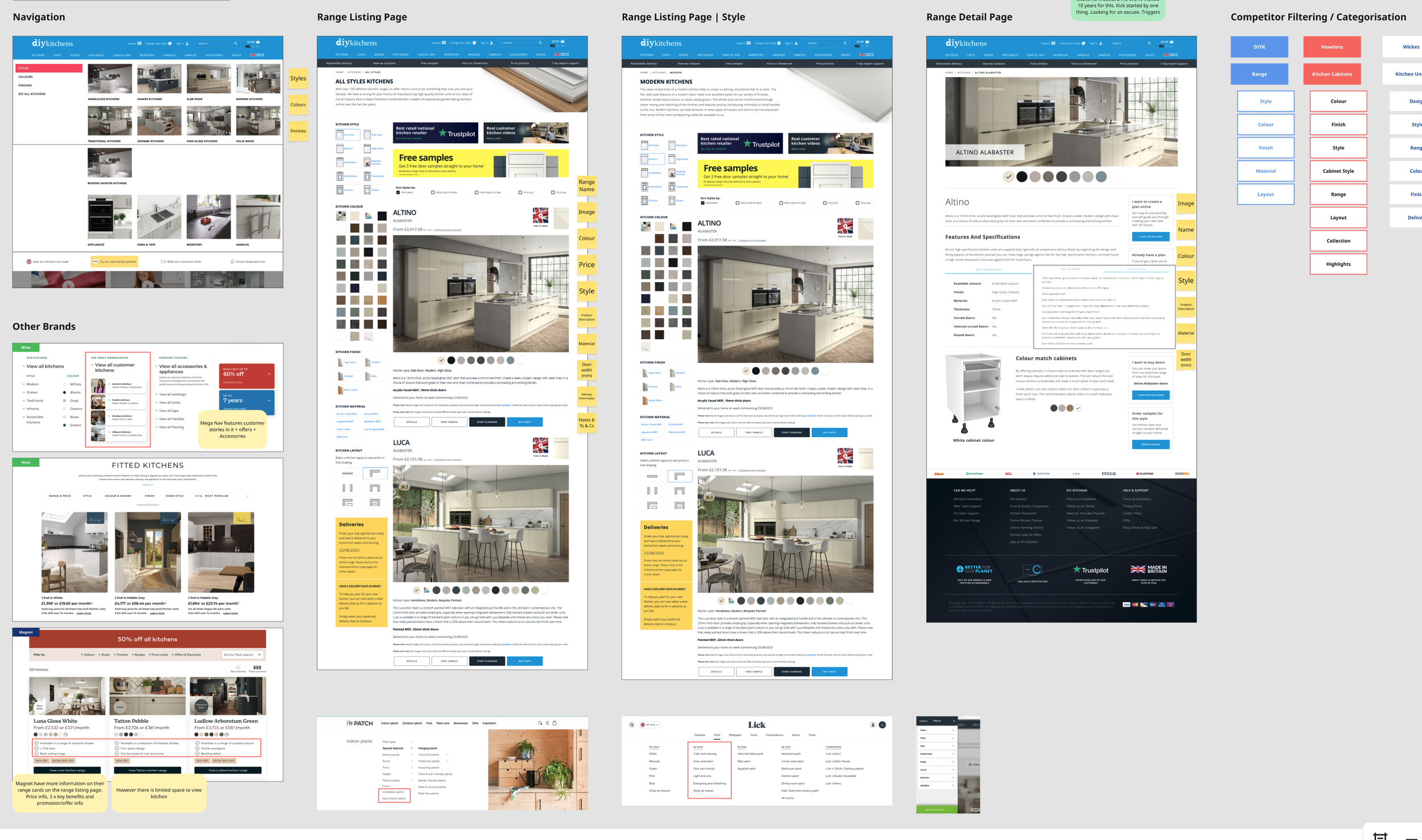
The service blueprint and customer research told us what the experience needed to do. The competitor audit told us what we had to build to be credible and show signs on where we could differentiate. We audited DIY Kitchens in depth, with supporting analysis across Howdens, IKEA, B&Q, Wren and Magnet. Each finding fed directly into MVP scope.
Parity with DIY Kitchens
Granular product data and precision filtering
DIY Kitchens and Howdens had the most developed product data of any competitor; precise measurements, multiple filters and detailed specifications. This wasn't coincidental. Their primary users are kitchen fitters who need to locate an exact item fast, not browse. Filters therefore had to work much harder. Paula Rosa's existing product catalogue was built for internal use and couldn't support this out of the box.
If we got this wrong
The kitchen planner relies on granular measurements to size accurately. Vague product data means vague plans and therefore customers lose confidence and leave.
→ MVP requirement: full product data redesign before catalogue goes live
Where PRK could differentiate + win
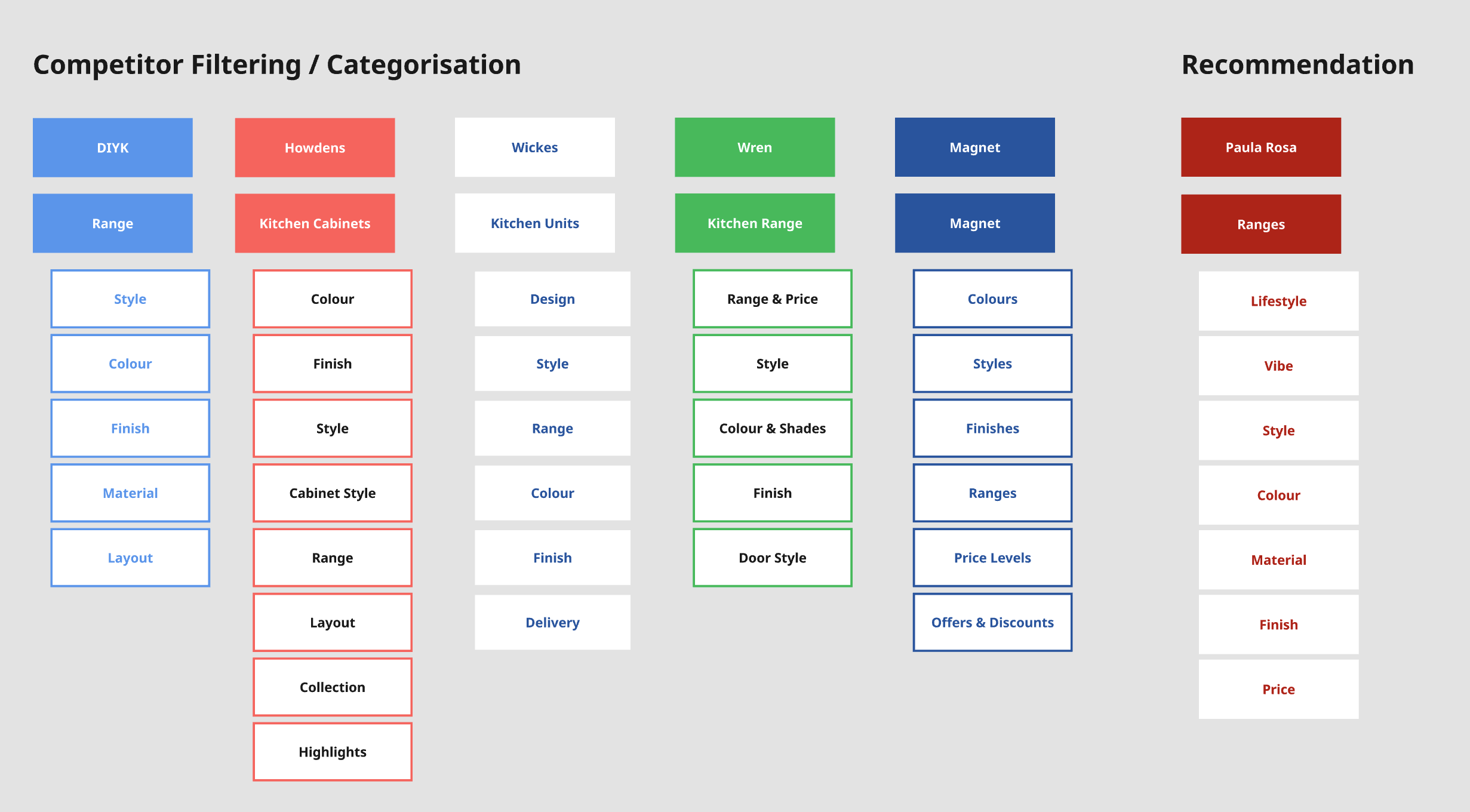
Nobody was helping customers shop by personality or lifestyle
Every competitor organised their catalogue by product type, range, or colour. This was the functional and correct way but it felt cold. What our customer research had surfaced was that buyers don't start with "I want a shaker door in navy." They start with a vibe; family friendly, creative cook, design-led. No competitor was bridging that gap. We recommended a lifestyle and personality-based navigation layer that connected a customer's instinct to a specific range, not sitting in product listing pages, but as a core feature of the early lifecycle tool upstream in the journey.
→ MVP differentiator: lifestyle quiz in early lifecycle tool, mapping personality to range
Informing the Product Data Architecture
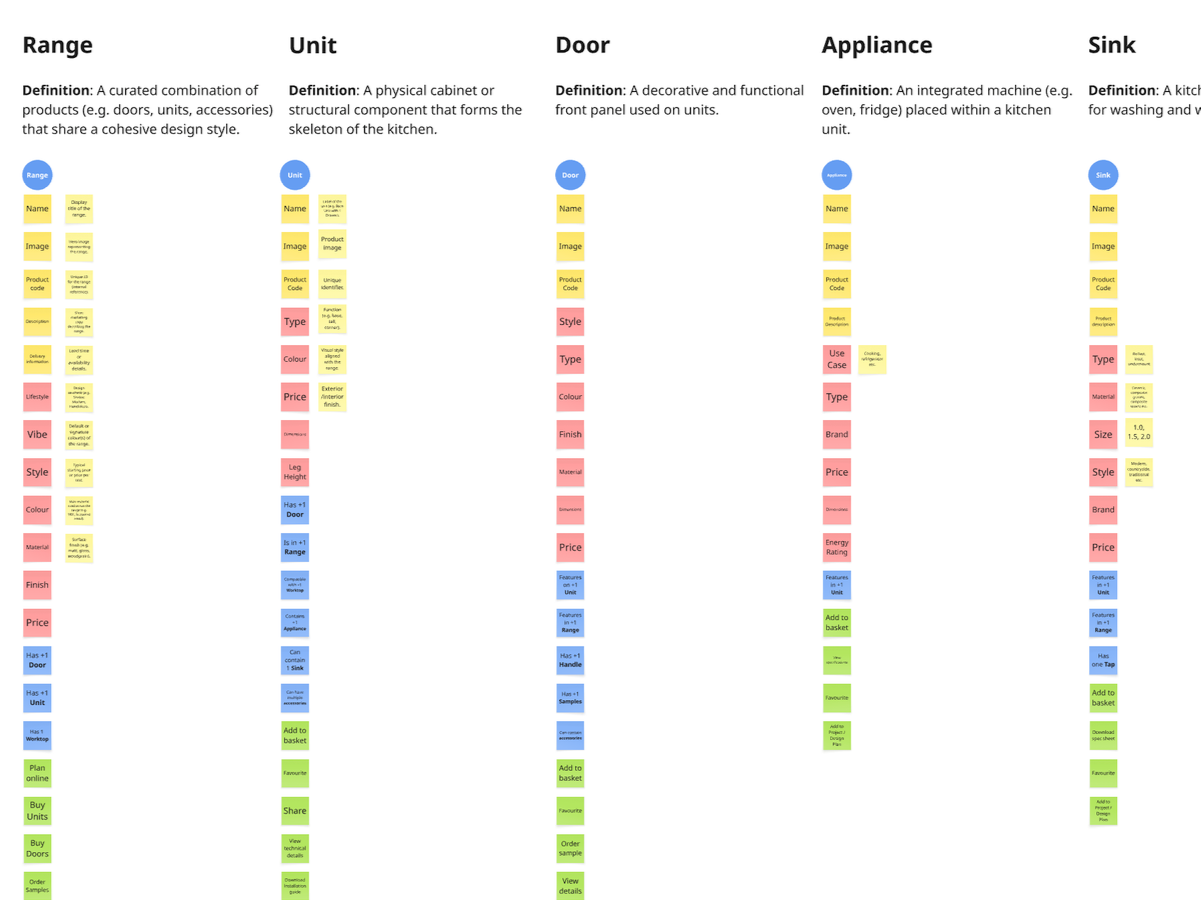
OOUX mapping: Revealing the attributes a standard audit misses
Object-oriented UX let us map the attributes that make up each kitchen component (or "noun" in OOUX terms) and surface the actions that can be taken against them. More powerfully, it revealed the relationships between every product type. Cabinets have doors; doors have compatible handles; handles have finishes. This directly informed the "customers also bought" logic on product detail pages, ensuring no dead ends in the shopping journey. A standard feature audit would have treated these as separate flows. OOUX showed them as a continuous purchase path.
→ Shaped: product filtering, cross-sell logic and product detail page architecture
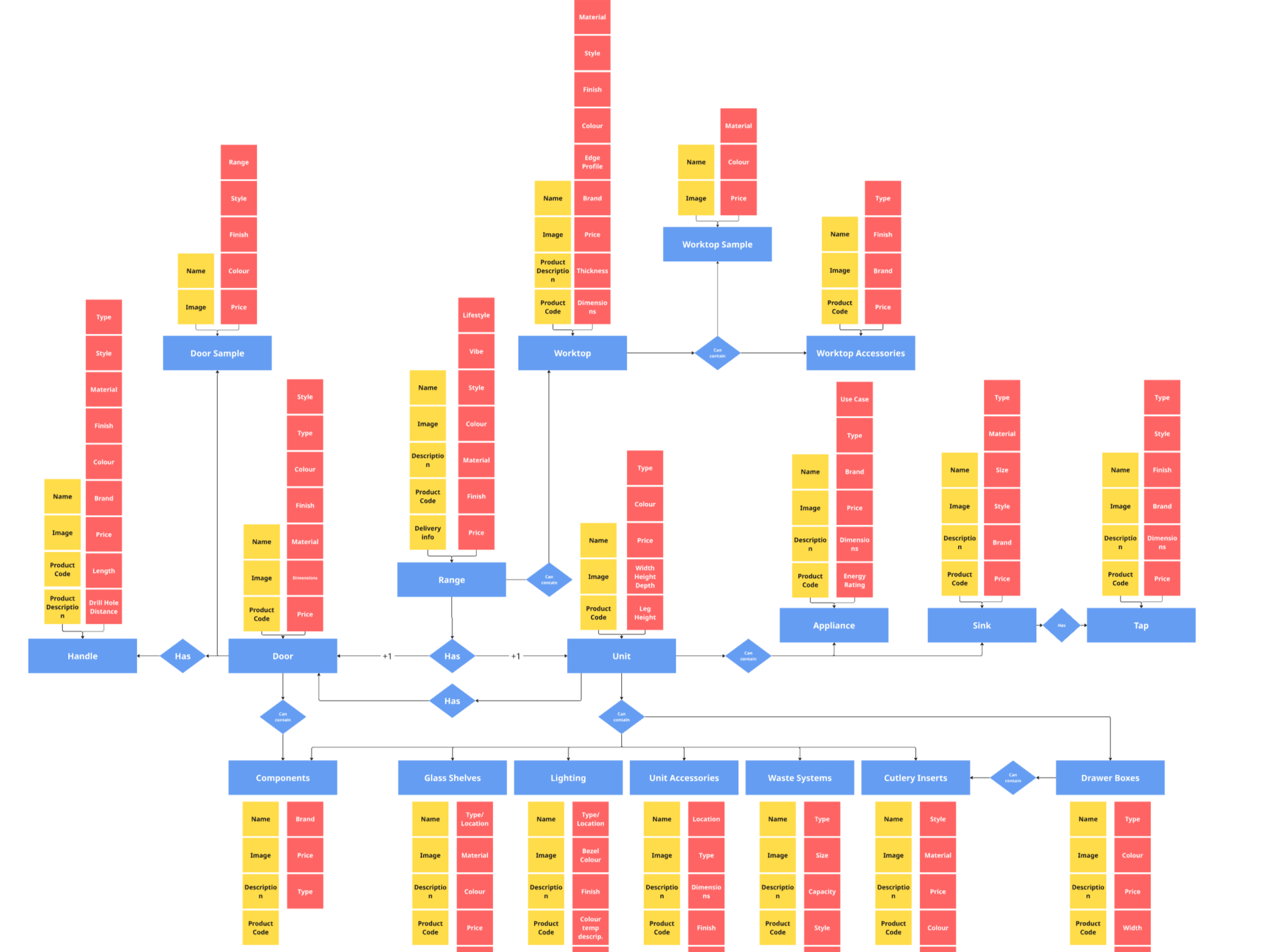
Entity relationship map: Translating product logic for the tech team
The entity relationship map was OOUX made visual; a structured diagram of how product components related to each other at a data level. Its primary audience was the tech team, who needed it to accurately scope how backend systems would connect product pages, planning tools, and the catalogue. It directly informed technical sizing and shaped what was feasible to include in MVP scope versus what would need to come later.
→ Shaped: backend scoping, tech sizing, and MVP feasibility decisions
MVP Scoping: What we prioritised & why
Working with Mattie, we moved from a long feature list to a scoped, tech-sized MVP using three prioritisation principles. My role was to define the early lifecycle tool options, write user stories in Jira, size design effort per feature, and drive the deprioritisation rationale on specific calls.
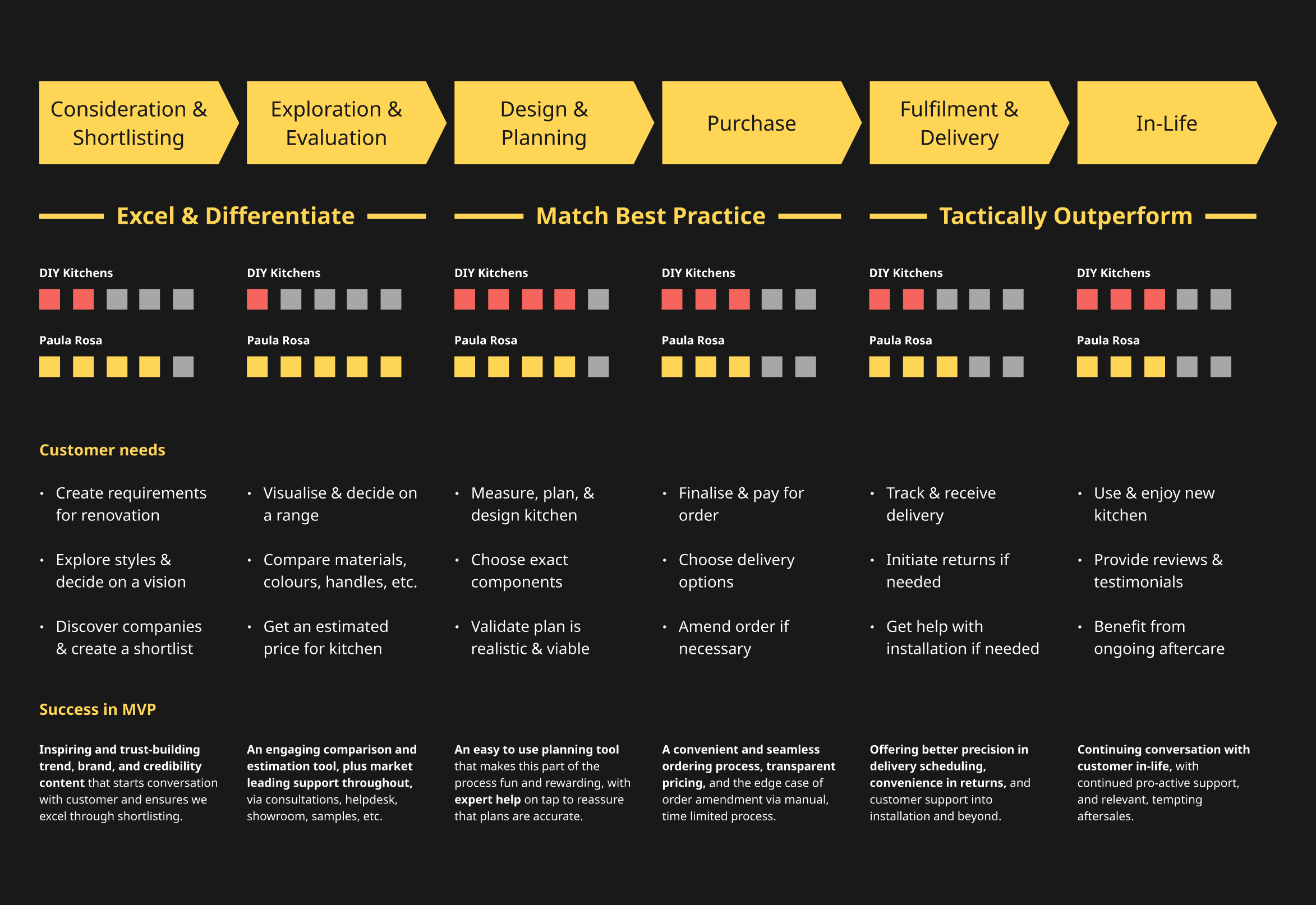
Our three prioritisation principles
Principle 01
Match DIY Kitchens on the fundamentals
Feature parity with the market leader was the baseline. Without it, Paula Rosa wouldn't be credible in the space.
→ Parity first
Principle 02
Differentiate where DIY Kitchens falls short
Early lifecycle experience, content, and personality-led features. Areas the research showed customers needed and competitors ignored.
→ Then differentiate
Principle 03
Use integrations to reduce build complexity
Where a third-party tool could handle complexity; planning, logistics hand off rather than build. Keep MVP lean.
→ Stay lean
The Sizing Process
Step 1 - Created desirable features for MVP via Service Blueprint & User Story Map
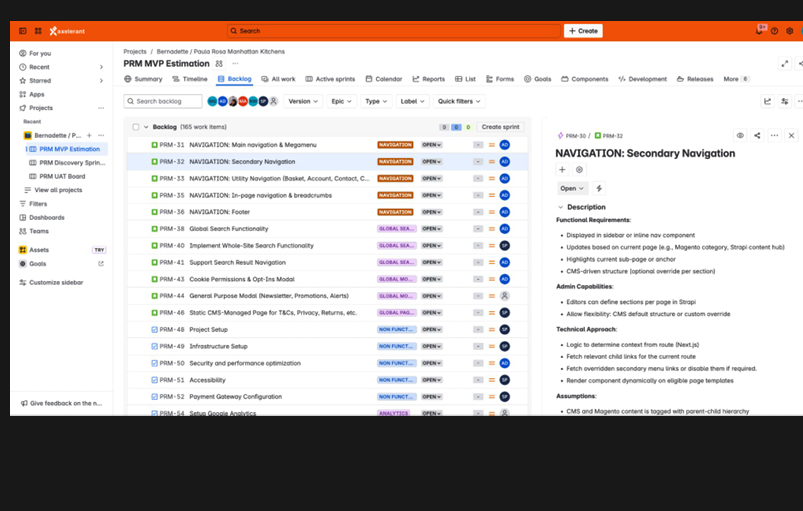
Step 2 - Detailed features in collaboration with tech partner
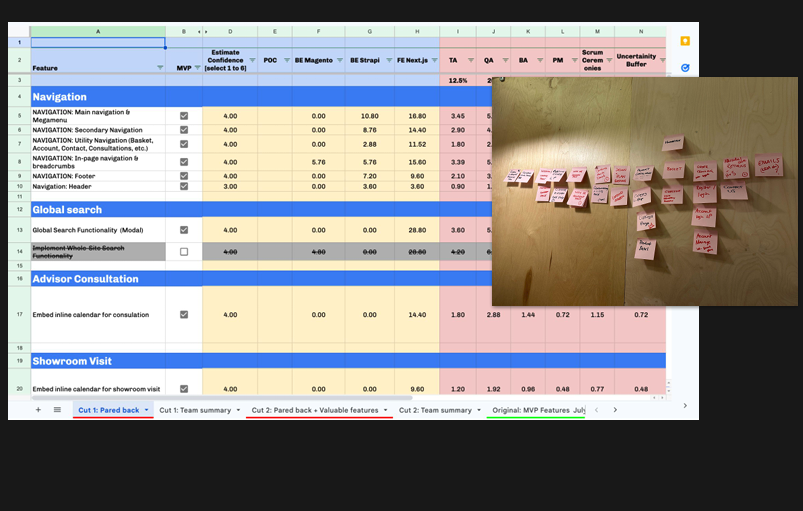
Step 3 - Tech partner sized features to create initial estimate and we sized design effort
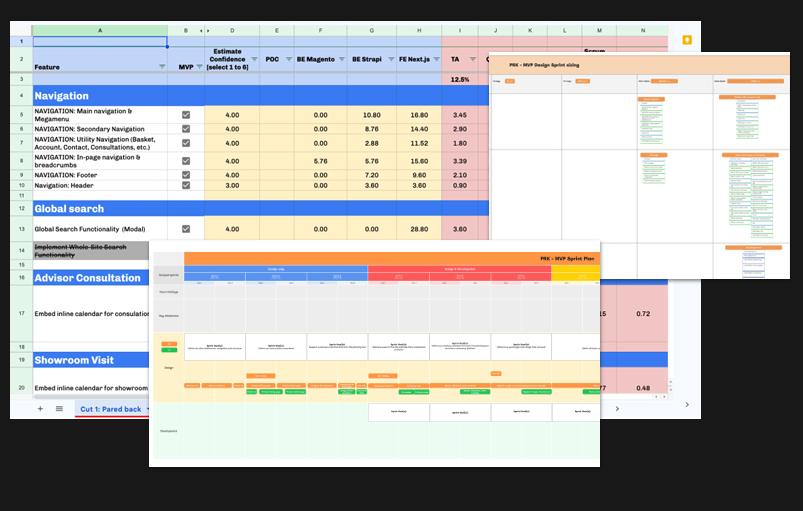
Step 4 - Descoped features & rationalised design complexity to create MVP
What was in, out and later
In MVP
Content pages
Product catalogue with restructured data
Customer reviews and real kitchen photography
Third-party planning tool integration
Ecommerce Capabilities
Order tracking, delivery & returns
Account Management
Support CRM with automated returns flow
Newsletter Sign-up
*Early lifecycle tool (range finder + estimator)
Cut from MVP
Bespoke components for brand, credibility or inspiration content
Embedded social / Instagram feeds
Planner tool set-up questions
Content search
Branded planning tool guidance content
Wishlist / save-to-planner feature
Dynamic 3D visualiser in lifecycle tool
Later
Full lifestyle and personality quiz
AR kitchen visualiser
Granular order tracking statuses
In-home design consultation booking
The Key Differentiator
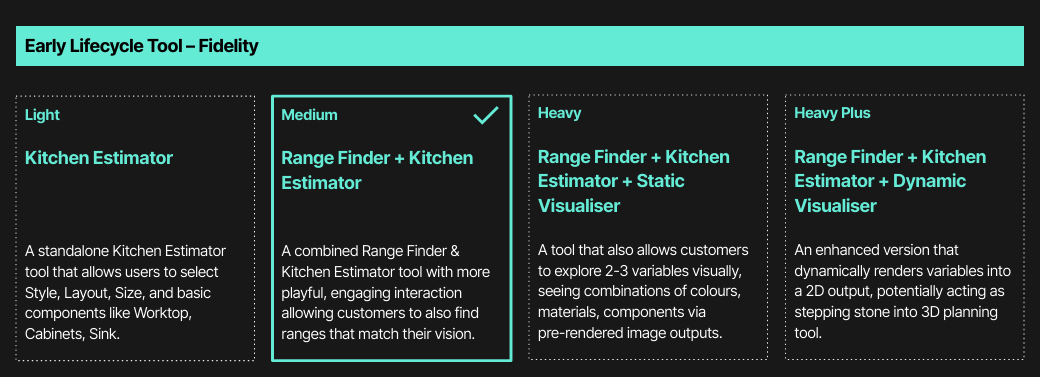
The early lifecycle tool - and why it was worth the complexity
This wasn't in the original brief. It came directly from research, customers were abandoning before they even reached the planner because the jump from browsing to planning was too large. The tool would act as a bridge: a lightweight range finder and cost estimator that gave customers a starting point before entering the third-party planner. Pre-saved selections meant no blank slate. Warmer leads for marketing. Higher conversion into planning. More completed plans and higher average order value. We scoped four fidelity options for the client, from a basic estimator to a dynamic visualiser to let them make a cost-informed decision on how far to take it.
The call I pushed back on: Wishlisting
Wishlisting was cut on cost grounds. I disagreed, saving items from the catalogue directly into the planner would have reduced the blank-slate anxiety our research had flagged, and made the handoff between Paula Rosa's site and the third-party tool feel connected rather than disjointed. It was deprioritised, but I flagged it as the highest-value quick win post-launch.
Outcomes & what happened next
The project stalled shortly after handover. Paula Rosa were broadly aligned with the strategic vision but the gap between pre and post-MVP sizing created a budget constraint that paused progress. I left the company during this period to travel.
What launched
DIY Kitchens parity build first
The early lifecycle tool was descoped from v1. Paula Rosa opted to launch, test internal operations against the service blueprint changes, and introduce the lifecycle tool in a later phase. A reasonable sequencing call.
Handover signal
Artefacts held up without me
Across a personnel change and a period of budget pause, the work remained actionable. The incoming designer delivered from the original outputs, a signal of how clearly the rationale had been documented.
What I would track in the first 90 days
Planner abandon rate - Primary signal of friction. A high rate validates the lifecycle tool argument.
Planner to basket conversion - Whether completed plans are converting — or dropping at the final step.
Average order value (AOV) - Whether customers are building full kitchens or browsing single items.
What I’d do differently
Prototype and test the early lifecycle tool before scoping it
The lifecycle tool was our strongest differentiator and the feature with the most build complexity, but we went into MVP scoping without having validated the concept with a single user. A lightweight prototype tested with five or six recent kitchen buyers would have given us evidence to push harder for it, choose the right fidelity level with confidence, and make the case to the client more concretely. We were arguing from research inference but we should have been arguing from observed behaviour.
Push for a less legacy-bound brief
The project was anchored to replicating DIY Kitchens. That was commercially pragmatic but creatively limiting, and I think it capped the potential AOV. My instinct was that the bigger opportunity was a more immersive, guided buying experience: inspiration-led entry, a personality and style questionnaire, AI-assisted visualisation, feeding directly into the planner with pre-configured selections. Less traditional e-commerce, more guided purchase journey. It would have been a harder sell and a larger build but it would have targeted full kitchen purchases rather than individual components, with a meaningfully higher return. Given more time I'd have built the commercial case for it properly rather than letting the brief set the ceiling.